
In New York, theatre exists everywhere.
In small black box spaces, in borrowed rooms, on busy street corners, and on the grand stages of historic Broadway halls. It exists in the spaces between other commitments, in the hours carved out to make something that did not exist before. It is part of the city’s fabric—woven into its history, its neighborhoods, and its rhythms. Not confined to a single district or scale, but present in ways both overt and invisible, shaping how stories are shared and experienced across the five boroughs, and how the quintessential New Yorker is understood across the globe.
For independent theatre producers, this sense of scale does not arrive pre-assembled. The work emerges piece by piece—often beginning with an idea, and the understanding that everything needed to support it will have to be built over time.
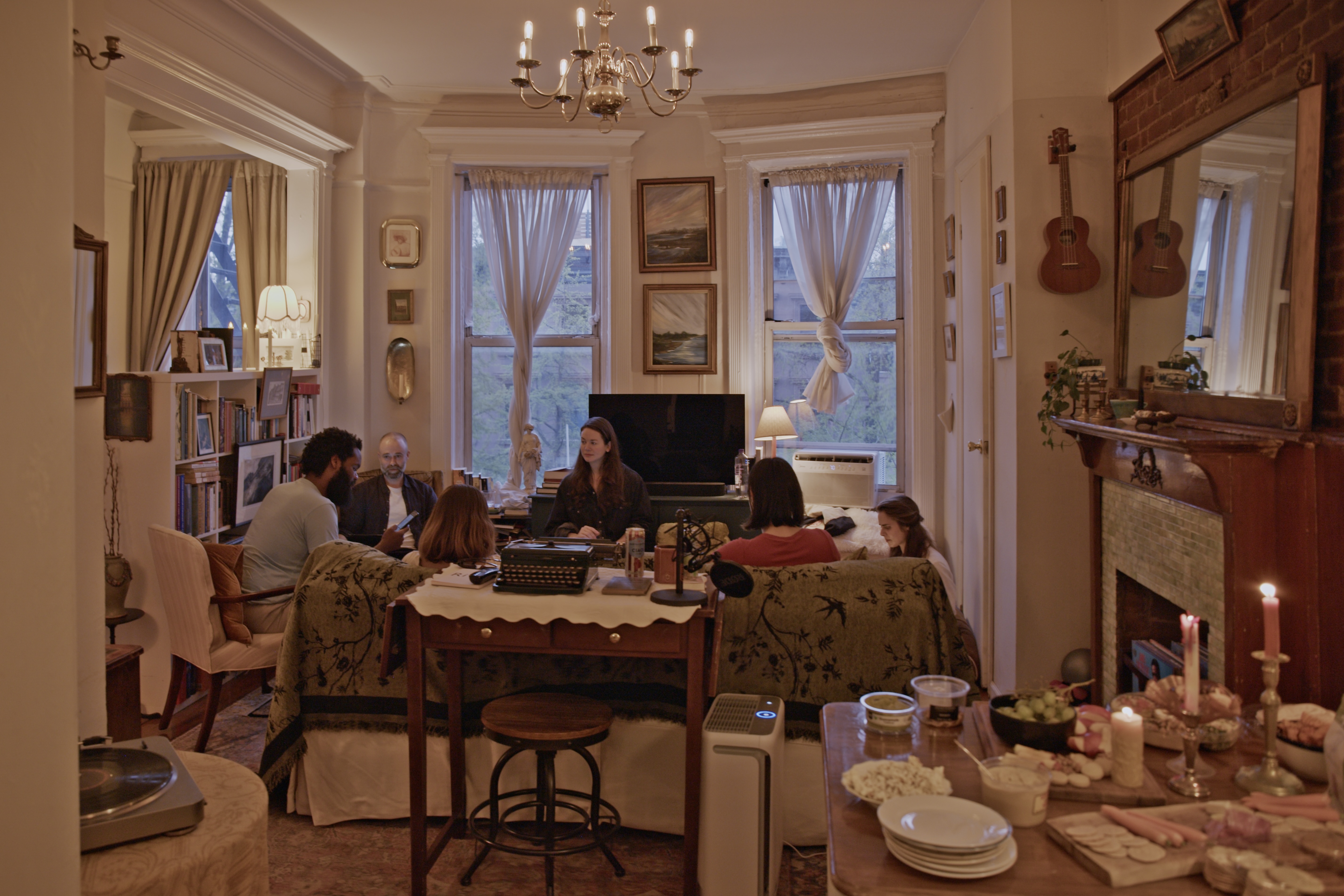
For Living Room Productions, that beginning was not a formal production, but a gathering.
The first potluck took place in the summer of 2023. Ten or fifteen people in an apartment. A green tiled fireplace as the stage. Candles arranged as footlights. There was live music—composer Will Healy improvising while a short story in progress, written by Su Hendrickson, was read aloud. Original songs, play readings, live painting. Food everywhere.
“It just felt like a really good hang,” says Ellyn Heald, founder and artistic director. “No agenda, no industry networking, no performance of professionalism. Just artists in a room together, sharing what they were working on and actually paying attention to each other.”
What lingered was not the scale of the gathering, but the quality of attention within it.
“Ten people in a living room doesn’t sound like much,” she says. “But the energy in that room felt like the beginning of something.”
Theatre has always begun in gathering—in the shared act of storytelling, of witnessing, of making meaning together. That impulse has carried across centuries, taking different forms but rooted in the same exchange between people.
In a contemporary independent context, that foundation remains, even as the work becomes more complex.
On any given day, “producing” might mean negotiating a rental in the morning, sending fundraising emails at lunch, coordinating a reading in the afternoon, and meeting with collaborators that night.
“Producing independently means [messages to] the artistic director, the operations lead, the marketing team, the finance team all go to the same inbox—mine,” Ellyn says. “You get good at shifting gears, and you get better at being honest about what can actually have your full attention in any given hour.”
The work does not unfold in sequence. It moves in parallel—multiple threads advancing at once, each shaped by the conditions around it. What is imagined and what is possible are in constant dialogue, each informing the other. In this dynamic environment, constraint is not something that appears later in the process. It is present from the beginning, quietly shaping the work as it finds its form.
“Budget is the constraint people assume, and it’s real,” she says. “But time is the tighter one. Everyone involved is building this alongside other work, other jobs, other lives. Space is next—finding a room in New York that fits the vision and the timeline and the bank account is its own puzzle.”
And yet, the work does not contract in response. It adapts.
Decisions are made in real time. Priorities shift. The question becomes less about what is missing, and more about how to build with what is available; including how to reach the people the work is meant for.
“When resources are limited, every detail carries more weight,” Ellyn explains. “I think a lot about what an audience feels from the moment they receive an invitation to one of our shows to when they leave the theater. Every detail matters and should feel intentional—that’s what makes people feel they were part of something, not just present for it.”
What emerges is a way of working that is both constrained and expansive; limited in resources, but not in intention, and defined not by what is unavailable, but by how deliberately each element is shaped and shared.
As the work grows, so does the need to sustain it.
At Living Room Productions, that commitment begins with the artists themselves.
“We’ve made an unwavering commitment to paying our artists,” Ellyn says. “No one should work for free, even though that remains an all-too-common practice in New York’s independent theater scene.”
That commitment shapes everything that follows. Fundraising is not a separate phase, but an intrinsic part of the ecosystem, woven into the process of building the work and the relationships that sustain it.
“Fundraising isn’t a once-a-year ask,” she says. “It’s part of everything we do. Every dollar goes directly toward what makes the work possible—paying artists, securing space, investing in design, keeping our shows accessible.”
Through the support of their community, Living Room Productions produced a full season of three shows last year. This year, they’ve taken a significant step forward with fiscal sponsorship through Satellite Collective, opening the door to larger individual donations and corporate support.
The next step takes shape tonight, 30 April 2026.
Eve of the First Spark, a spring gala in collaboration with MAD Company Theatre, brings together performance, community, and fundraising in support of upcoming projects, including Twelfth Night: 1941.
What began as a potluck becomes a gathering of a different scale—but rooted in the same idea.
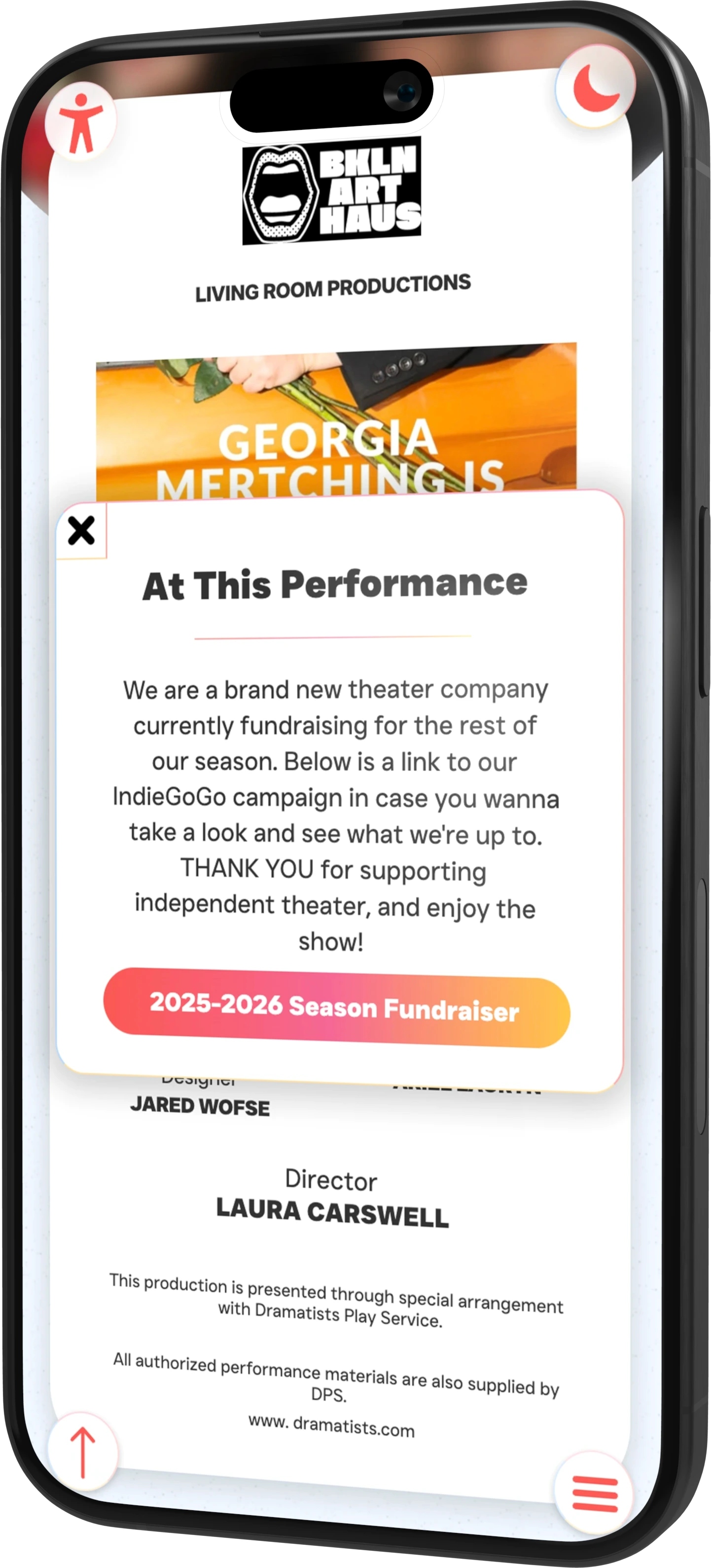
As the process becomes more supported, the nature of the work begins to shift. And for last year’s production of Georgia Mertching is Dead, that shift was immediate.
“Marquee was a genuine game-changer,” Ellyn says. “Beyond the immediate cost savings of going print-free, the real value was in the flexibility.”
Updates could happen in real time, mid-run, without reprinting a single page. Announcements could be added as needed. And most notably, the program itself became part of the fundraising process.
“We could link directly to our fundraiser,” she explains. “No more hoping audiences would remember a URL or hunt down a QR code. They could just tap through and donate in the moment when they were most engaged.”
“Marquee removed the friction between the ask and the action,” she says. “And that seamlessness made a real difference.”
The resources saved by making this switch were not abstract. “The time and money we recovered went straight back into the production itself.”
For independent theatre-makers, success is not fixed.
“Honestly, success is still being defined,” Ellyn says. “And I think that’s a good thing, because we’re still growing into what we’re capable of.”
But some priorities are already clear.
“I want to create real jobs for artists in this city. I want to lift up new voices—writers, performers, directors who haven’t had their shot yet. I want to prove, unambiguously, that excellent theater doesn't only happen on Broadway.”
That belief reshapes the scale of the work, but not its significance. Theatre can happen in intimate spaces, built by independent artists, and still carry the same weight—offering something immediate, specific, and fully realized. The measure is not the size of the room, but the clarity of the experience within it.
Accessibility sits alongside that belief. “Live theatre,” Ellyn says, “shouldn't only be for people who can afford a $200 ticket.” It can remain grounded, responsive, and within reach—creating space for audiences who are not looking for spectacle alone, but for something real, vital, and important.
Living Room Productions is expanding into film, audio plays, and new forms that allow them to reach audiences wherever they are, while continuing to nurture artists at every stage of development. But at its core, the work returns to the same place it began.
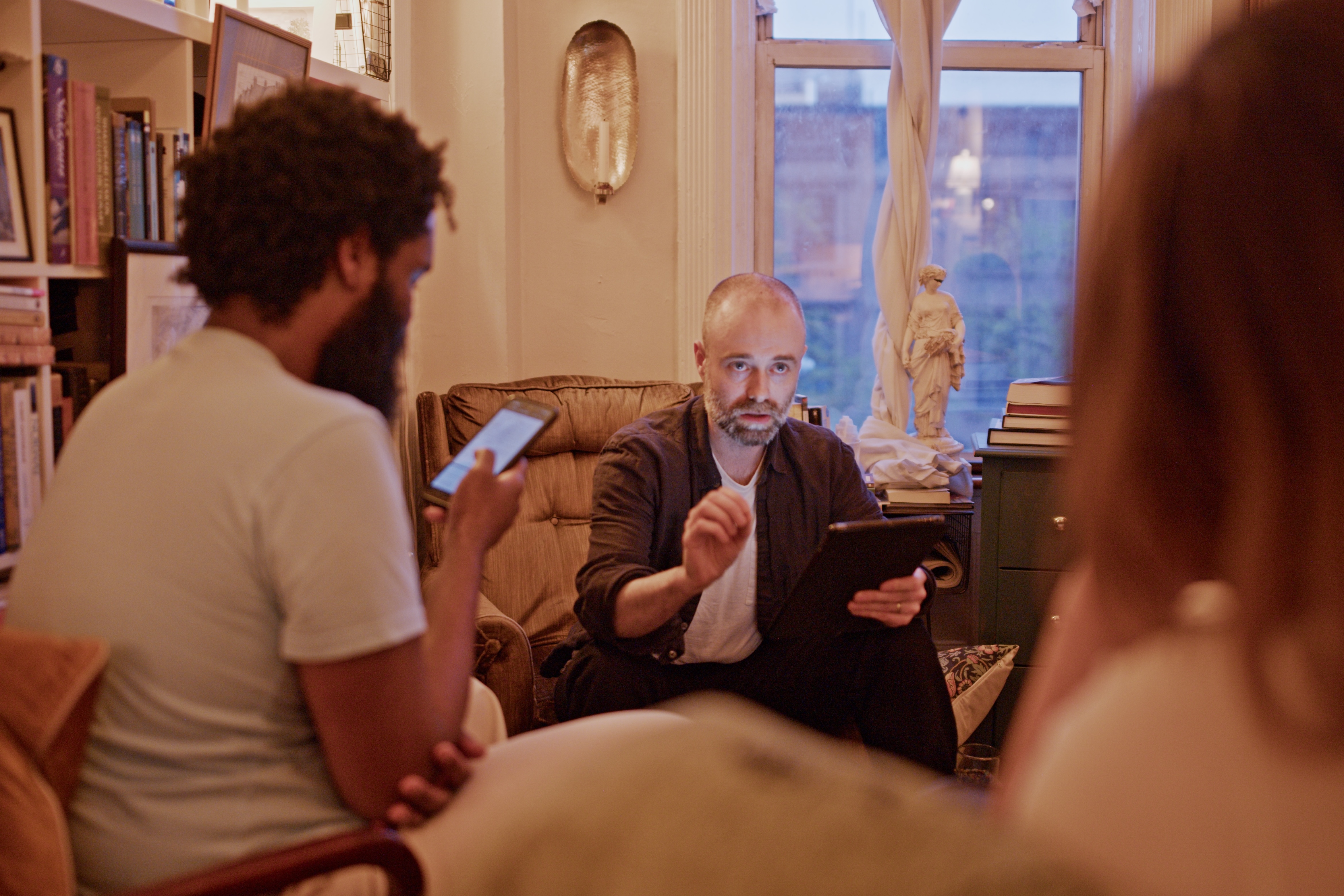
“The thing I’m most proud of is the community,” she says. “The potlucks have become something really special. People show up, they connect, they share work. Everyone is there for the same reason.”
Her goal for these gatherings is simple, and quietly ambitious:
“My dream is that one day The New Yorker writes about them. And I think we're going to get there.”
This piece was developed in collaboration with Living Room Productions. Photo of Ellyn Heald by YellowBelly Photo.

Be the first to read our articles.


LAND ACKNOWLEDGEMENT:
Marquee Digital, LLC resides in the ancestral homelands of the Munsee Lenape and Wappinger Peoples. We honor the history of this land and its people, and continue to grow our awareness of the ongoing consequences of colonialism and oppression still unfolding in our society. We commit to supporting and celebrating the life, work, and spirit of the Indigenous stewards of this land, and hold ourselves accountable to carry on the legacy of their careful stewardship with honor, integrity, and allegiance.
.jpg)