


.png)


The wife-and-wife team of Else and Emma Rose Went came out swinging last year with Initiative, a five-and-a-half-hour epic tracing the maturation of a high school friend group in the early aughts. Its sweeping scope reminded me of Degrassi: The Next Generation, which through sheer duration and character plurality stands as one of the most realistic depictions of people across time – somewhat paradoxically, considering its melodramatic swings, but also appropriately, due to the mundanity of life it encompasses. Else, the playwright, knit her characters’ online lives, DnD personas and real selves into a rich, sometimes fringed tapestry, which Emma Rose knew how to best display.
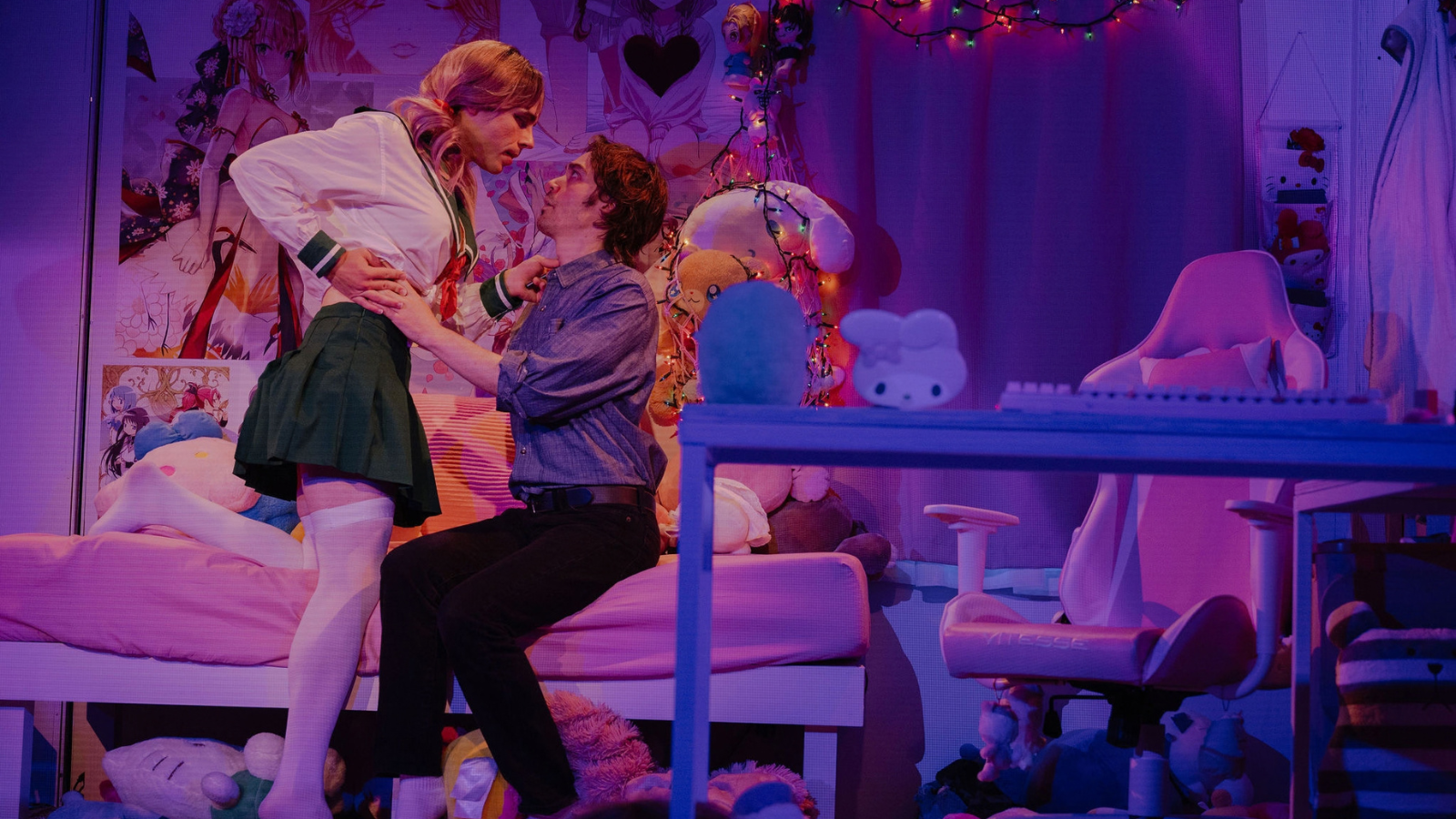
Their followup, Degenerates at Playwrights Horizons, is an even more ambitious, incisive and sometimes excoriating exploration of cyber-connected outcasts — in half the time. It centers on a trio of deeply isolated incels on an ongoing, audio-only Discord whose IRL identities complicate their red-pilling. The energy drink-swilling Miller (Zachary Desmond), the most assertive of them, is proof that intelligence and wit are morally moot in the Post-Truth era, his mind warped into knots of self-hate and self-denial. He bulldozes over Kemp (Tyler Nowell Felix), a sensitive Black anime fan at the end of his rope, and secretly (we learn) lusts after Target (Christopher Dylan White), a cosplay streamer blindly groping their way through gender.
Miller’s casual cruelty on the chat is sometimes aided by Target’s perspectives, and the latter’s connection to the group’s ringleader takes on an almost ride-or-die dimension until it’s cam-mode, and they manage to dom Miller into driving the hour and a half over to finally meet.
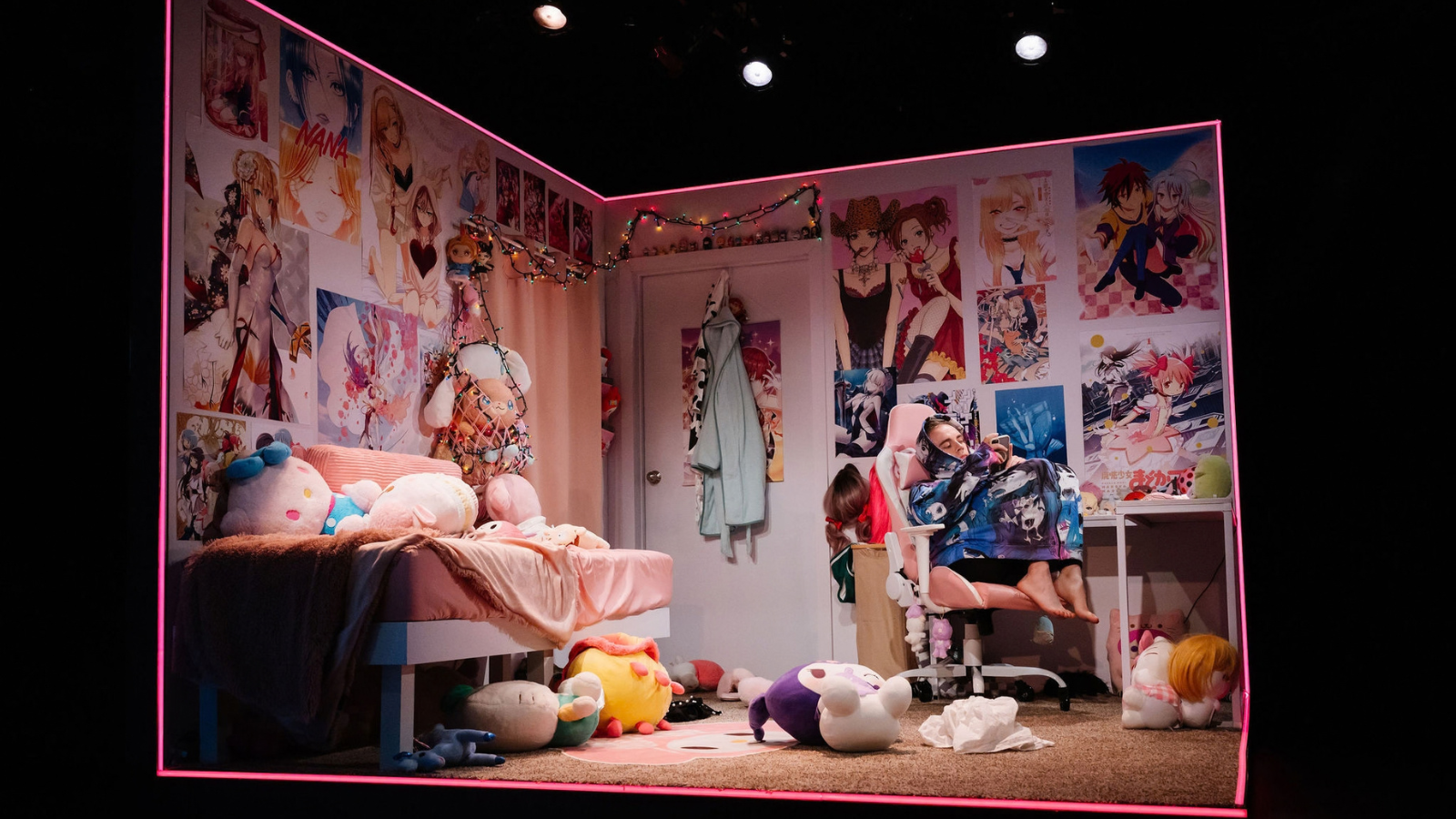
Else’s writing is excellent and insightful throughout; I don’t know how one doesn’t develop a permanent migraine wrangling this much online-ness into a single work (echoes of Circle Jerk), let alone such a cohesive and emotionally attuned one. It’s when Miller and Target meet, and Mikiko Suzuki MacAdams’ gorgeous scenic design allows their discrete spaces to physically come together, that Emma Rose presents some of the best stage direction today. (The production is aided by Kindall Houston Almond’s costume, Jiyoun Chang’s lighting, and S. Katy Tucker’s video and projection designs.)
Felix turns in a wonderful performance as Kemp, and Juan Arturo, who has gradually built a career out of left-of-center, beguiling work, briefly appears as a Meninist-adjacent cohort member. Olivia Rose Barresi, an Initiative alum, uses her empathy-1000 voice to heartrending effect during the suicide hotline call, performed in the dark, which opens the play.
But this is mostly a showcase for Desmond and White’s pas de deux, and both are remarkable. Desmond’s eyes as they stare at the object of his bewildered affection are lustful and deranged, violent and self-effacting all at once. (A sex scene later on is one of the most charged – and hottest – encounters I’ve seen onstage.) As the slipperier Target, White is a study of embodied etherealness. Both are extremely convincing in roles that are equally reactive and propulsive. Onstage for most of the play’s near-three hour runtime, they only augment or deconstruct their layered portrayals.
As in Initiative, there’s a streak of sentimentality to the playwright’s conclusions, though here it feels more like a touching call to humanity than a way to wrap up loose ends. To its credit (among many), Degenerates is extremely online, extremely today, but tapped into a graceful sense of truth that Went has undoubtedly mined from imagination, insight and experience. After all that onlineness, the Wents know how to ethically unplug.
~~~
Another tale of degeneration is being told at the always-great Irish Rep, which is restaging its 2006 production of The Hairy Ape, Eugene O’Neill’s 1922 war cry against class inhumanity. Ciarán O’Reilly’s production is a stunner, nimbly walking the line between the early career playwright’s expressionism and the realism he would later exemplify.
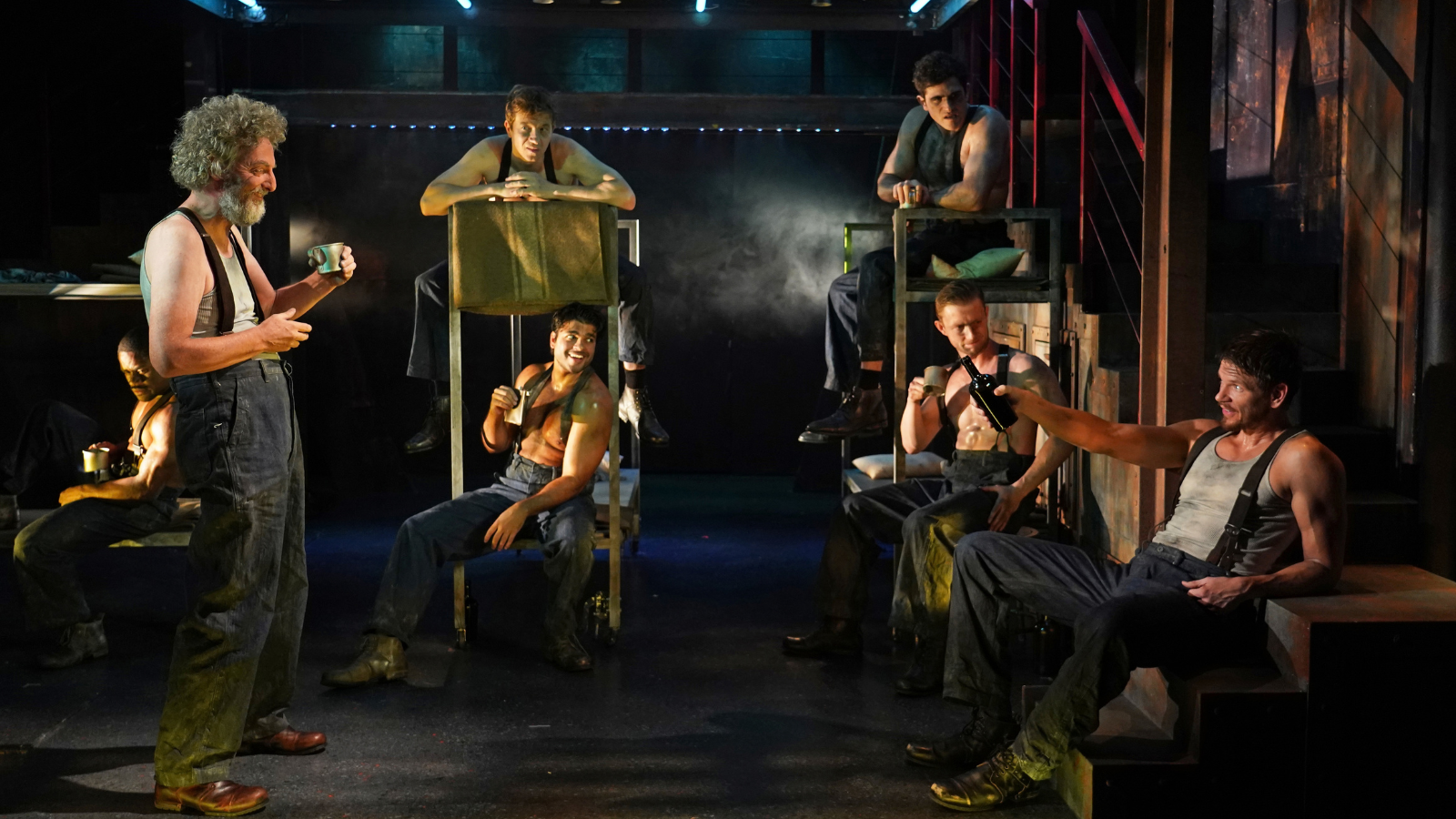
In the bowels of a fancy ocean liner, burly and surly Yank (Jon Beavers) considers himself the salt of the earth, mindlessly shoveling coal so that society industrialists like Mildred (Elizabeth Teeter) and her aunt (Joanna Glushak) can twirl their pearls on the lido deck. (Orla Long designed the costumes.)
When the younger social worker decides to take a peep at how the other half lives, she’s horrified by Yank and calls him a “filthy beast.” Once ashore, the now-destabilized stoker finds himself adrift in the early 20th century, trying his luck on Fifth Avenue, a labor meeting presided by a snooty organizer (perfectly played by Adam Petherbridge), and ultimately, the zoo.
Charlie Corcoran’s industrial two-tiered set (inspired by Eugene Lee’s design from 2006) is, perfectly, impressive to us and oppressive to its characters. Especially in scenes set in the ship’s stokehold, lit in smoky neon by Michael Gottlieb, the sense that these men could be crushed at any point is thrilling and palpable. O’Reilly stages much of the action downstage, emphasizing the presentational nature of the text, save for Mildred’s upstage entrance into the hellish stokehold.
That crucial moment is the only one to fall flat for me: the state in which Mildred perceives Yank might evince her cataclysmic insult, but is hardly crude or unimaginable enough to warrant fainting, and the ridiculousness of that gesture would likely rather cause Yank to scoff than begin an existential tailspin. But then, at least five days into performances, this Yank is not completely convincing.
Beavers has the brawn (we’ll overlook his hairless torso), and nails the initial scenes in which Yank, utterly secure in his station ("I start something, and the world moves!”), holds court against an older worker’s (John Keating) inkling of consciousness. But Beavers retains that surety throughout, even as Yank’s speech, as written, becomes more babble than bravado. There’s little there to suggest a man losing his grip, much less his place in the world.
It’s a game performance, regardless, as are the rest from the (rather sizable) cast, and O’Reilly presents the material truthfully and memorably enough to overcome flaws–even two which might otherwise sink a staging. The Hairy Ape, at least at Irish Rep, is never out of place.
I shudder to give a “But what if we queered it?” trigger-happy director the idea, but I wonder what a production with homoeroticism turned up a few degrees might look like. (The Id-forward trash collector at the center of João Pedro Rodrigues’ erotic shocker O Fantasma follows a similar trajectory of physical and spiritual degradation – he, too, is ultimately faced with the animal to which he is compared – and the film is not without its class critique.) The tableau on which O’Reilly’s staging opens proposes it could be done; I’ve seen that one before. Something that comments on brotherhood and homosociality, which critiques certain strains of leftism’s alignment of queerness and decadence. I don’t know, maybe I’m just into a righteous brute.
Degenerates is scheduled through November 1, 2026 at Playwrights Horizons on West 42nd Street in New York City. For tickets and more information, visit here.
The Hairy Ape is scheduled through November 15, 2026 at Irish Rep on West 21st Street in New York City. For tickets and more information, visit here.
.png)
What Will The Neighbors Say? Theatre Company will bring their 13th original production, ¡FRUTAS!, to the stage as part of their 11th season in April 2027.
Co-artistic directors James Clements and Sam Hood Adrain announced the company is beginning development on the production, which is a multidisciplinary documentary theatre play exploring the 1954 Guatemalan coup d'état. The full bilingual (English and Spanish) script combines dance, farce, Bouffon clown work and 360° video design, coupled with a source-based script, to create a delirious, manic fever dream.
The Neighbors are launching the second cycle of their New to the Neighborhood residency. The program was initially created by the Neighbors with the support of the Howard Gilman Foundation and the Brooklyn Arts Council, and is intended to be an incubator for Brooklyn-based early-career artists who are members of underrepresented communities. While all can apply, the program is specifically seeking residents who are female, trans or non-binary writers of the Global Majority living in Brooklyn. Residents will be announced in October, ahead of a December residency and presentation in collaboration with The Brick in Brooklyn.
Beginning in 2027, the Neighbors will be in residence at the Library for Arts and Culture at Brooklyn Public Library in Downtown Brooklyn, working with local constituents across a variety of sessions. In the Spring, the Neighbors will run eight workshops, every other Tuesday, each with an hour of interactive artistic sessions run by a different Brooklyn-based artist and an hour of guided generative creation.
In Fall 2027, during their twelfth season, the Neighbors will combine primary research with the self-scripting, creative writing and interviews from the Spring to craft a new piece of documentary theatre that explores how Downtown Brooklyn, and indeed the wider borough, has changed over the last 100 years. This will culminate in a free public presentation/installation in December 2027, featuring Brooklyn-based creatives and stakeholders.
The Neighbors will also host nine talkbacks throughout Classic Stage Company’s 2026-27 season, for shows including Clifford Odets’ “Waiting for Lefty,” directed by Steven Pasquale, “Come Back to the 5 & Dime Jimmy Dean, Jimmy Dean,” by Ashley Robinson, Dan Gillespie Sells and Shakina and the New York premiere of “Wonder! A Woman Keeps a Secret” by Pulitzer finalist Talene Monahon.
To follow along with What Will The Neighbors Say Theatre Company’s upcoming season, visit here.
.png)
As if there was ever any doubt, you may consider it confirmed: Jocelyn Bioh and Broadway are a match made in heaven.
Bioh, a gifted Ghanaian-American playwright and actress, already proved her Broadway writing bona fides three years ago with Jaja’s African Hair Braiding, a bitter-edged comedy premiered by Manhattan Theatre Club in 2023. Now Bioh’s breakout play School Girls; Or, The African Mean Girls Play receives its well-deserved Broadway debut, again at MTC’s Samuel J. Friedman Theatre and under the direction of Tony Award nominee Whitney White.
School Girls first delighted New York audiences off-Broadway in 2017, presented at that time by MCC Theater in a breakout moment for Bioh. Bitingly witty, this smartly constructed comedy transports us to the Aburi Girls Boarding School in 1986 Ghana, where a sharp-tongued crew of young ladies are competing for a chance to become “Miss Ghana 1986.”
Queen bee Paulina (Denée Benton), the resident “Regina George” of the crew, has little doubt that local pageant recruiter Eloise (Patina Miller) will select her for national consideration. That is until Ericka (Jasmine Amy Rogers), a transfer student from Ohio, swoops in to disrupt the balance of power.
Ericka’s arrival sets off a chaotic chain of events by turns uproariously funny, stingingly painful and, for anyone who lived through teenage bullying, cruelly familiar. Yet Bioh always keeps her tone two or three notches above naturalism, allowing the audience guilt-free enjoyment in reliving all these excruciating memories. It’s a tricky balance, one that White negotiates expertly for this high-energy Broadway revival.
.png)
That new arrival Ericka is of a lighter hue, in contrast to the other girls’ darker skin color, opens up an equally knotty conversation around colorism that Bioh handles with care. Ericka’s privilege is plainly acknowledged. But, as in all of Bioh’s writing, empathy overflows. Every character faces their own challenges, and each gets their moment to be seen. All of them, as a result, feel like fully-rounded individuals. Cartoonish individuals, to be sure (deliberately so), but fully-rounded all the same.
If Bioh overdoes it anywhere, it is perhaps with the character of Paulina. That this seemingly heartless bully will be revealed to have deep-seated insecurities is not a shocker, nor is it intended as one. We know the tropes that Bioh is playing in here, and she knows that we know them. All the same, Paulina’s eventual turn can feel a bit too heavily telegraphed, particularly in Benton’s affected portrayal. And though verisimilitude is far from the goal of this production, casting the 34-year-old Benton as an 18-year-old proves a bridge too far. (Though I did adjust to it, eventually.)
The ensemble here is, otherwise, faultless. Jasmine Amy Rogers lights up the stage as always, and subtly reveals the operator hiding under Ericka’s outward warmth. Patina Miller delightfully chews the scenery, while Heather Alicia Simms has fun with the Headmistress’ barely-concealed disdain for Eloise. The true MVPs of School Girls, though, are the other four young women, who provide much of the play’s heart. Lucia Aremu, Nia Otchere-Sarfo and Jordan Rice all have fun playing out their own mini-arcs, while fast-rising star Erin Morton lends Nana an unforced dignity that grows, by the play’s end, into a quiet fabulousness.
School Girls is now in performance at the Samuel J. Friedman Theatre on West 47th Street in New York City. For tickets and more information, visit here.


