


.png)


.png)


%20copy.webp)


.png)
As a New Yorker headline rightly reminded us just this week, Bill Irwin is “The OG Clown.” The legendary performer is also a perfect fit to portray self-pitying hypochondriac Monsieur Argan in Molière's farcical comedy The Imaginary Invalid, now receiving an enjoyable revival under the auspices of Roundabout Theatre Company. But if you’re looking for evidence of Irwin’s masterful physical talent, his ability to mime, contort and twist his body into pretzels, you’ll find sadly little of it in director Brandon J. Dirden’s straightforward staging.
Upon reading Roundabout’s announcement of an Invalid revival earlier this year, I assumed that a clown-forward interpretation was this production’s impetus. After all, we’ve hardly lacked for Invalids of late. A delightfully befuddled Mark Linn-Baker led an enjoyable revival from Red Bull Theater last summer, around the same time that Molière in the Park took a crack at it. I also fondly recall an all-male version performed at Bard Summerscape back in 2012, led by Peter Dinklage as Argan’s strong-willed maidservant Toinette. In Dinklage’s hands, plucky Toinette was practically bouncing off the walls as she maneuvered to pair off Argan’s daughter, Angelique, with the man she truly loved.
That tempestuous central battle should be the energetic center of any Invalid, but in this new adaptation (written by Irwin himself), the battle between Argan and Toinette feels oddly subdued. That is partly due to Irwin’s scene partner, Crazy Ex Girlfriend’s Rachel Bloom, who chooses to lean into a droll wryness. Bloom does well when playing the role of fatigued commentator on the action—her rueful asides to the audience land strongly. But there should also be a deeper bond with Argan, and that isn’t felt. Bloom ultimately just feels a bit low energy.
So too does Irwin, who is oddly muted (at least by his standards) as Argan. One could argue that the role is to blame. As written, Argan spends much of the play seated, and confused, and one step behind. He reacts a lot. But couldn’t this production have found some device or method to crack the text open and give its central clown an opportunity to let loose? Since Irwin did the adapting himself, I suppose this is how we wanted it. Who knows why.
.png)
Dirden’s production actually opens with one daring gesture, a wittily choreographed opening dance inspired by the traditions of commedia dell’arte. As a masked Irwin conjures a set from all sides, seemingly willing the play to begin, he is beset upon by other bodies. Irwin’s fellow performers finally pull red streamers out from inside the man, like his intestines are being ripped from his body. It’s a delightful image. But this sequence is a one-off, and everything that follows is fairly expected.
Thankfully, the remaining members of this superb theatrical ensemble are ready to step in and provide the clownery. Outside of Irwin and Bloom, everyone else on stage is operating at a far higher intensity of buffoonery, and all are a delight. The ever-reliable Brooks Ashmanskas provides foppery to spare, while Crystal A. Dickinson is hilariously ridiculous as Argan’s calculating wife Beline. And Hiram Delgado has tremendous fun as Angelique’s repulsive suitor Thomas.
And somehow Daniel Croix Henderson and Ava Lalezarzadeh, as young lovers Cleante and Angelique, manage to nearly walk away with the production. The roles are typically the play’s dullest, but this sprightly pair are so enjoyable lively, so full of pep and step, they shine brighter than anyone else on stage. A compliment to Irwin, I suppose, that he is happily letting someone else steal the show.
The Imaginary Invalid is now in performance at the Todd Haimes Theatre in New York City. For tickets and more information, visit here.
.png)
Parents, right! That Parenting Musical (Studio Cast Album) will be released in streaming and digital formats on Friday, Oct. 23. The album features Christopher Jackson, Kara Lindsay, Bonnie Milligan, Max Mendoza Crumm, Vidushi Goyal, and Scott Rathbun. That Parenting Musical, which ran off-Broadway in 2024, features book, music and lyrics by Graham and Kristina Fuller. The album is produced by Ian Kagey, Dan Graeber, Graham Fuller, and Kristina Fuller, with Blue i Productions LLC and 19K Productions, LLC serving as executive producers. Casting of the album is by Eisenberg Casting, Daryl Eisenberg, CSA. The album’s orchestrations are by Dan Graeber, who also serves as music director.
Inspired by their real-life parenting journey, Graham and Kristina Fuller set out to write a musical that accurately reflects modern parenting, including all the unique joys and pitfalls. “The material, whether comedic, dramatic, or just plain messy, was too good to pass up,” Kristina Fuller said in a statement. “We thought, ‘this can’t just be happening to us, right?’ What we’ve learned through writing this show is that what we were going through is, in fact, universal.”
That Parenting Musical features a wide array of musical styles, from doo-wop to hip hop, Gilbert and Sullivan patter to ‘80s rock, Motown to musical theater and more. The show follows two bleary-eyed young parents as they trudge through the trenches and discover their post-baby identities.
Theatrely has an exclusive first listen to “Yoga Pants” featuring Kara Lindsay, Bonnie Milligan, Vidushi Goyal, and Scott Rathbun. Listen below:
The musical focuses particularly on early parenting from a child’s birth through kindergarten. It was first developed in Colorado, and transferred to New York in 2023 for further development, which culminated in a 2024 Off-Broadway production at Theatre Row in New York City, produced by Ember Productions.
To pre-order or pre-save That Parenting Musical, please visit the label HERE.

Playwright Jon Robin Baitz extends tremendous empathy to every member of the central family in Other Desert Cities, his 2011 drama now receiving a high-wattage Broadway revival led by Seinfeld and Veep star Julia Louis-Dreyfus. Yet for myself, finding resonance in Baitz’s 15-year-old work required viewing every character on stage with a degree of retroactive contempt.
If regarded with such disdain, the central Wyeth clan become—at least by the play’s conclusion—something fascinating. This wealthy Republican dynasty become a kind of root cause, a frightening representation of the apathy, disengagement and cynicism that led us to our current political moment. It’s an intriguing notion, at least to me. Whether it is remotely the intention of either play or production, of course, is another question.
A critical hit and Pulitzer finalist back in 2011, Other Desert Cities is set in the deserts of Palm Springs, California in Bush-era 2004 as the Wyeths gather on Christmas Eve. Family patriarch Lyman Wyeth (Ed Harris), an actor-turned-ambassador who shifted into Republican politics under Reagan, is a kindly figure. His wife Polly Wyeth (Julia Louis-Dreyfus), a former screenwriter and leftist whose politics lurched rightward to match her husband’s, has a crueler nature. Polly’s embrace of a GOP power player status has strained the dynamic with her sister Silda (Allison Janney), a fiery liberal and barely-recovering alcoholic.
Eldest daughter Brooke (Lily Rabe) brings home an unwelcome holiday surprise: the manuscript of her new memoir, a book focused on the radicalization and death of her older brother Henry. Brooke is still struggling to recover from the loss of Henry, who joined a radical underground movement and ultimately took his own life after an attack by the group left one person dead. These are not events that her parents wish to relive, and despite an effort by younger brother Trip (Joe Keery) to defuse tensions, Brooke’s new book re-opens old wounds and dredges up long held family secrets.
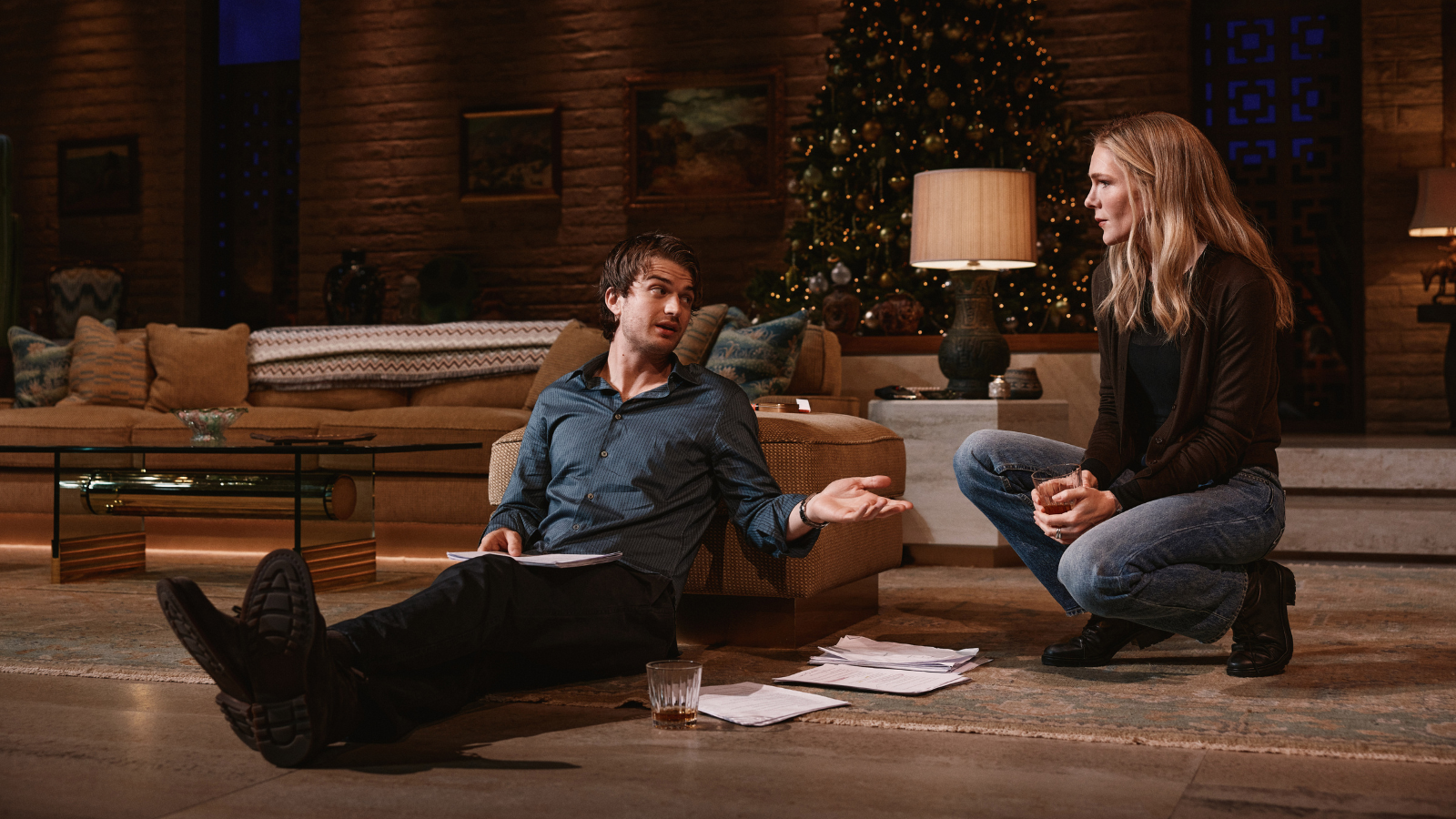
Other Desert Cities is an undeniably satisfying piece of narrative drama, tightly constructed and rigorously paced. Baitz doles out information with careful precision; each mini-confrontation flows naturally into the next, building a detailed overall picture; satisfyingly deployed monologues flesh out each character with compassion and care. This is, formally speaking, a very good play.
The deftness of Baitz’s dramatic construction offsets, here, a merely serviceable staging by director John Benjamin Hickey for this revival (at the Hudson Theatre, through January 17). Best known as an actor, Hickey’s only previous Broadway credit, Plaza Suite, was a brutally languid affair. Hickey certainly fairs better here, but his blocking is noticeably awkward, leaving actors to wander on-and-off stage uncertainly; and much of Baitz’s sharp dialogue is deployed sluggishly by actors who should be spitting the words like acid.
Of the production’s two genuine cast standouts, one is unsurprising: stage veteran Lily Rabe is both heartbreaking and appropriately annoying as Brooke, a high-intensity individual struggling with deep wells of pain. Rabe is not exactly restrained here, but her severity feels truthful. A greater surprise is Joe Keery, of Stranger Things fame, a natural stage presence who carefully reveals the confusion and torment lurking under Trip’s surface aloofness.
Harris and Janney, both stage veterans, feel oddly underpowered in roles that should land much stronger. The keen political operator under Lyman’s sweetness scarcely registers, while Janney’s halfhearted delivery is a far cry from the blistering intensity that Judith Light brought to the role 15 years ago. (I did not see her live, admittedly, but those YouTube clips are seared indelibly into my memory.)
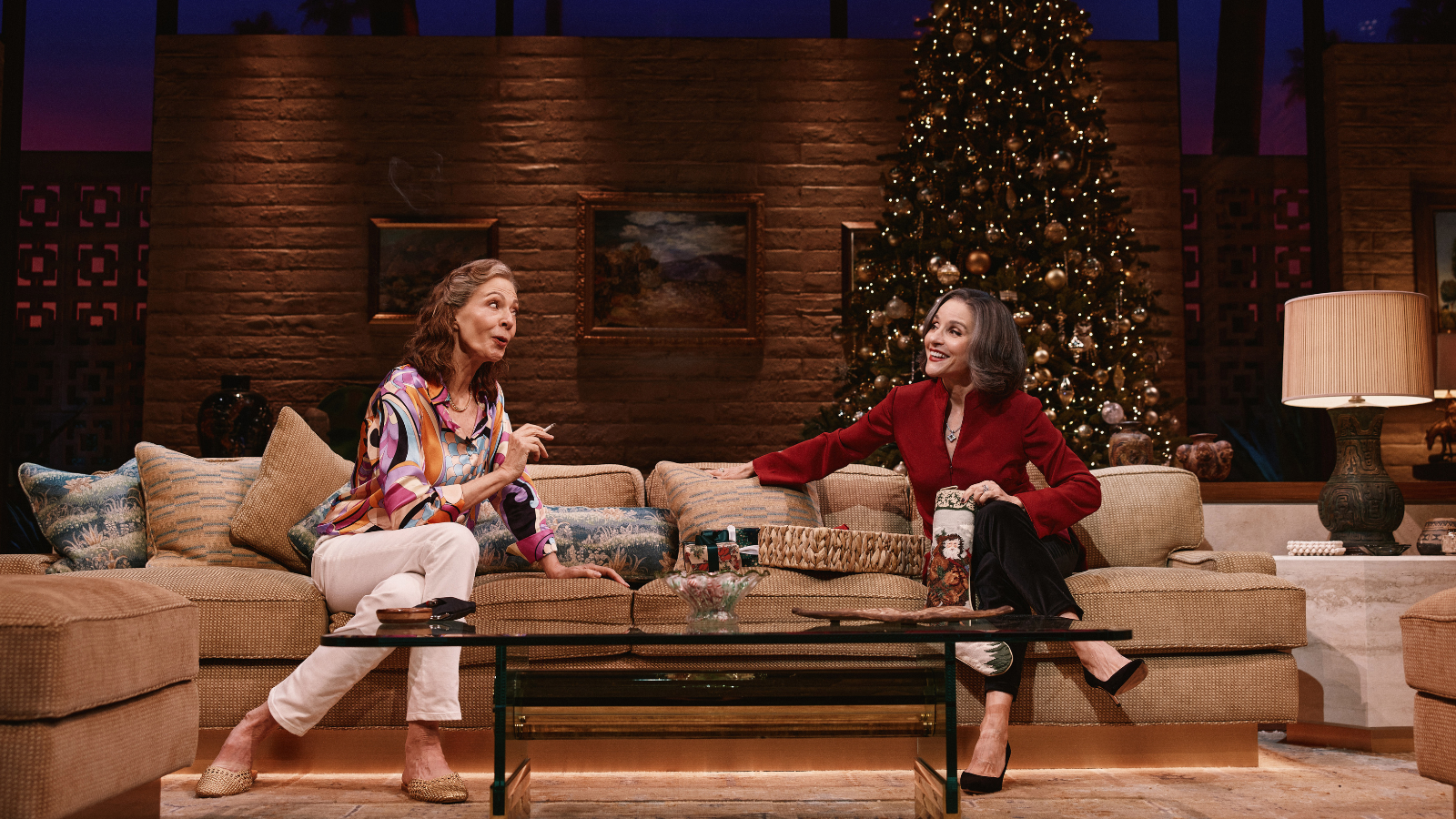
Perhaps Janney should have swapped roles with Louis-Dreyfus, who sadly cannot muster the regal status demanded by the matriarch role of Polly. (Louis-Dreyfus is also saddled with a hideous wig, a distractingly ugly gray bob.) The Seinfeld and Veep star lands her character’s cruel barbs as punchlines, and does get the laughs. But Polly’s demeaning, occasionally racist remarks should reveal a truly vicious figure. Instead, she feels sitcom-mean, à la Selina Myer, rather than truly heartless.
Of course, one could argue that Polly isn’t supposed to be a total void of emotion, which brings us back to the play’s intriguing contemporary resonance. Baitz’s play builds to a reveal that seems intended to throw our previous understanding of Polly and Lyman into stark relief, suggesting the two are far less heartless than they appear. But for me, the reveal had much the opposite effect, seeming to confirm the pair’s obsession with pristine surface appearance over any genuine care for others.
“You can do what you like after we’re gone!” begs Lyman at one point, imploring his daughter to delay her book. “Do you not understand that? It’s simply good manners.”
“I am past the point of good manners,” insists Brooke.
She’ll end up going back on these words, moved by a family secret that feels like a variation on the previous cruel lie. The tragedy of this play’s ending, to me, is that of its only character with any remaining principle ultimately giving up, and giving in to ease and comfort.
Given how Hickey directs the final scenes, I doubt he shares this viewpoint; he and Baitz likely see it as a more nuanced affair. And in 2011, perhaps it still was. But today, one can trace a lot of pain and suffering to the Pollys and Lymans of the world, power players who prized “good manners” over speaking truth. All of this gives the conclusion of Other Desert Cities a depressing kind of resonance, if perhaps not the kind its creators intended.
Other Desert Cities is now in performance at the Hudson Theatre on West 44th Street in New York City. For tickets and more information, visit here.


