

Artboard-25
Artboard-25
Artboard-25
Notes
Local
Connect
News
People
Media

Grantors

No items found.

Sponsors

No items found.

Sponsors

Donors

Donors

No items found.
Meet Our Donors

Tributes

Tributes

No items found.
Our Tributes

Performers

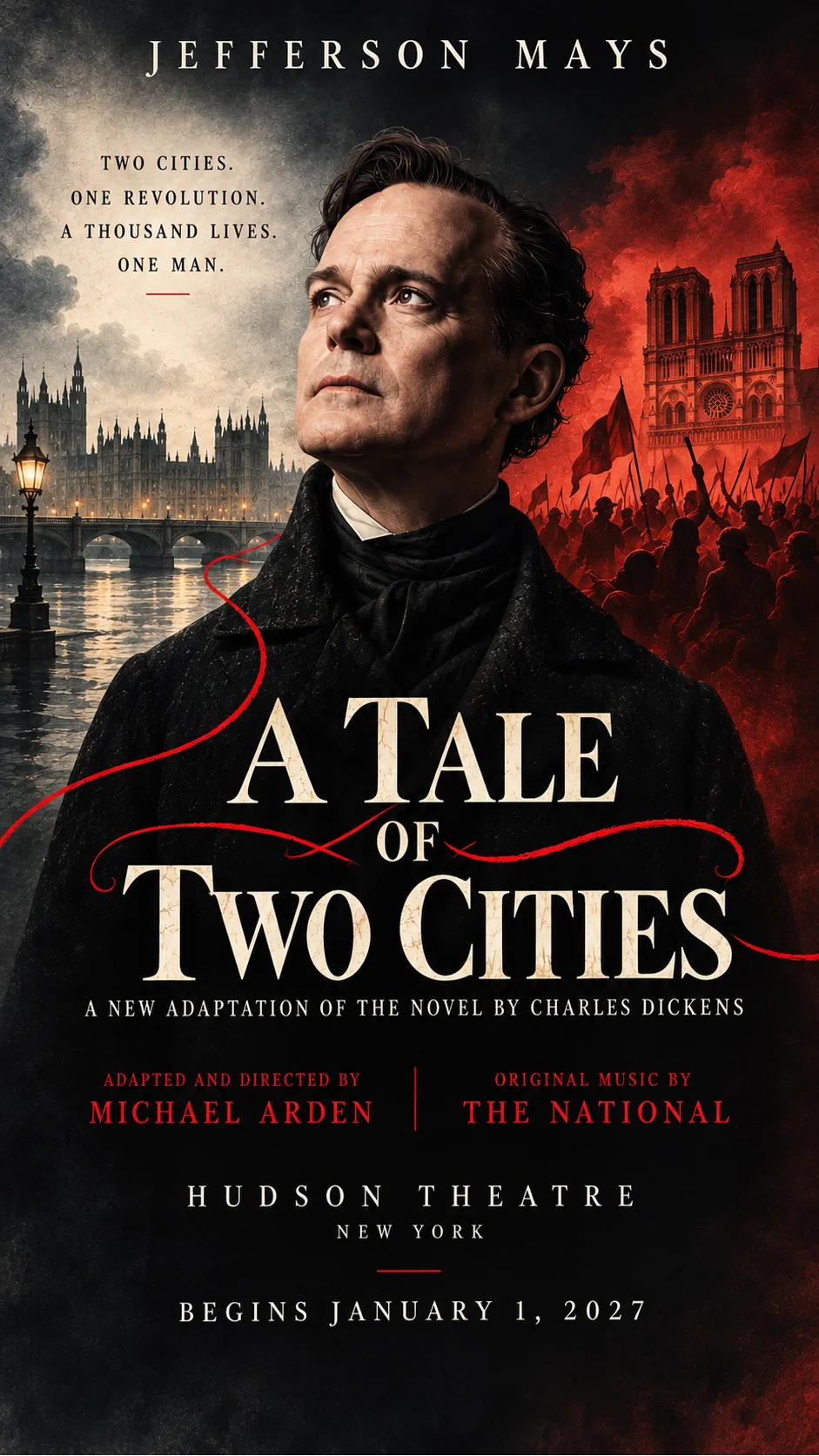
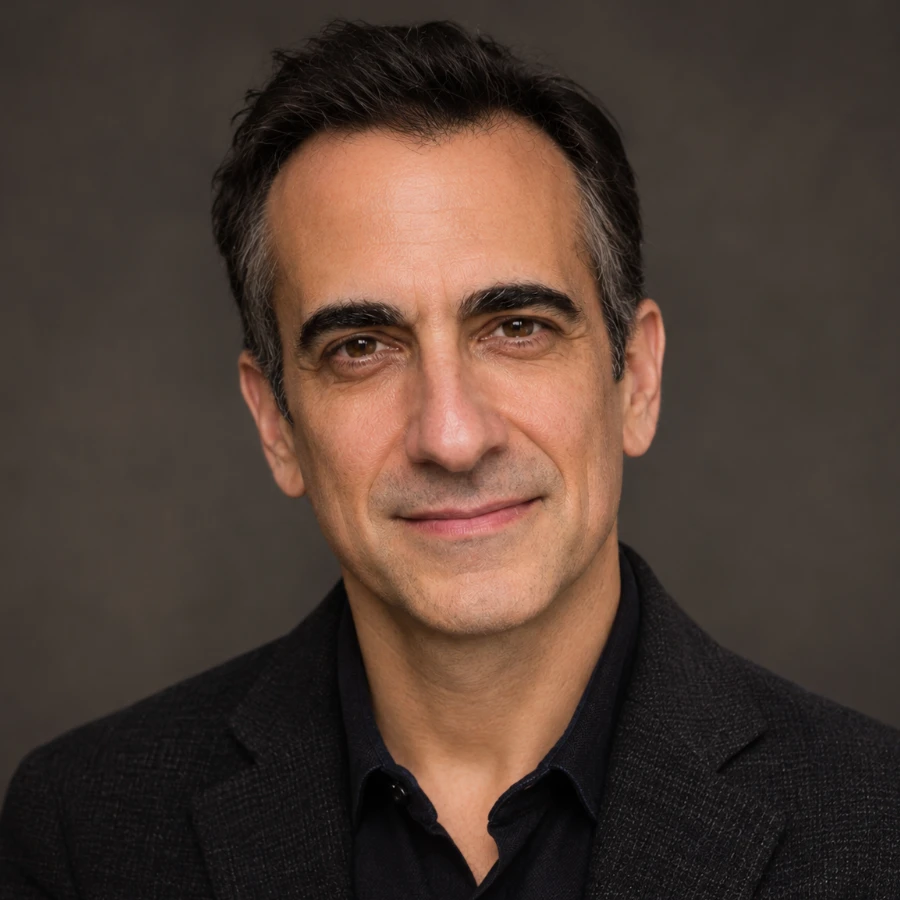
Jefferson Mays

*

The Company

David Pittu

*

u/s The Company

Setting

London and Paris, 1775–1793.

Please silence all electronic devices before the performance. It is a far, far better thing to turn off one's cell phone than to have it ring during the final scene.

Songs & Scenes

Act I
The Dover Road
England, 1775
Recalled to Life
Tellson's Bank, London
The Wine Shop
Saint Antoine, Paris
The Shoemaker
The Defarges' Garret, Paris
A Trial for Treason
Old Bailey, London, 1780
A Promise of Love
Soho, London, 1781
Act II
The Marquis
Paris and the French Countryside, 1780s
The Fall of the Bastille
Paris, July 1789
The Prisoner of La Force
Paris, 1792
The Tribunal
Revolutionary Court, Paris, 1793
The Seamstress
La Conciergerie, Paris
A Far, Far Better Thing
Place de la Révolution, Paris, 1793

Production Staff

Stage Adaptation
Michael Arden
Original Music
The National
Director
Michael Arden
Scenic Design
Dane Laffrey
Costume Design
Ann Hould-Ward
Lighting Design
Ben Stanton
Sound Design
Darron L West
Music Supervisor & Arrangements
Aaron Dessner
Music Direction
Amara Okafor
Projection Design
Aaron Rhyne
Movement Direction
Lorenzo Pisoni
Dramaturg
Eleanor Whitcomb
The Telsey Office
Casting
General Management
Blackwell Theatrical Group
Production Management
Meridian Production Services
Press Representative
North & West Public Relations
Production Stage Manager
Rebecca Ellis

Venue Staff

School Administration Staff

No items found.

Musicians

Piano & Keyboards
Amara Okafor
Violin & Viola
Elise Moreau
Cello
Gabriel Laurent
Percussion & Electronics
Thomas Mercer
Harp
Maeve Donnelly

Board Members

Student Advisory Board

Credits

Lighting equipment from PRG Lighting, sound equipment from Sound Associates, rehearsed at The Public Theater’s Rehearsal Studios. Developed as part of Irons in the Fire at Fault Line Theatre in New York City.

Special Thanks

The producers gratefully acknowledge the following individuals and organizations for their invaluable contributions to this production:

​

The Dickens Fellowship\

For keeping the extraordinary world of Charles Dickens alive for generations of readers and theatregoers.

​

The Society for the Preservation of Lost Causes\

For reminding us that even the most unlikely heroes deserve a second act.

​

Tellson's Bank\

For more than two centuries of discretion, dependability, and an admirably conservative approach to interior design.

​

The Defarge Family\

For their tireless dedication to community organizing and the textile arts.

​

The Citizens of London and Paris\

For their patience during a particularly turbulent period of theatrical research.

​

And, most especially, Charles Dickens\

For giving us two cities, hundreds of characters, and approximately 135,000 words to fit into one evening.

​

No aristocrats were harmed in the making of this production.

*Appearing through an Agreement between this theatre and Actors’ Equity Association, the Union of Professional Actors and Stage Managers in the United States.

“Actors’ Equity Association (“Equity”), founded in 1913, is the U.S. labor union that represents more than 51,000 actors and stage managers, Equity fosters the art of live theatre as an essential component of society and advances the careers of its members by negotiating wages, improving working conditions and providing a wide range of benefits, including health and pension plans. Actors’ Equity is a member of the AFL-CIO and is affiliated with FIA, an International organization of performing arts unions. www.actorsequity.org

United Scenic Artists ● Local USA 829 of the I.A.T.S.E represents the Designers & Scenic Artists for the American Theatre

ATPAM, the Association of Theatrical Press Agents & Managers (IATSE Local 18032), represents the Press Agents, Company Managers, and Theatre Managers employed on this production.

A Note from the Director

A Welcome from the Producers

The Music of A TALE OF TWO CITIES

Cast
Creatives

Meet the Cast

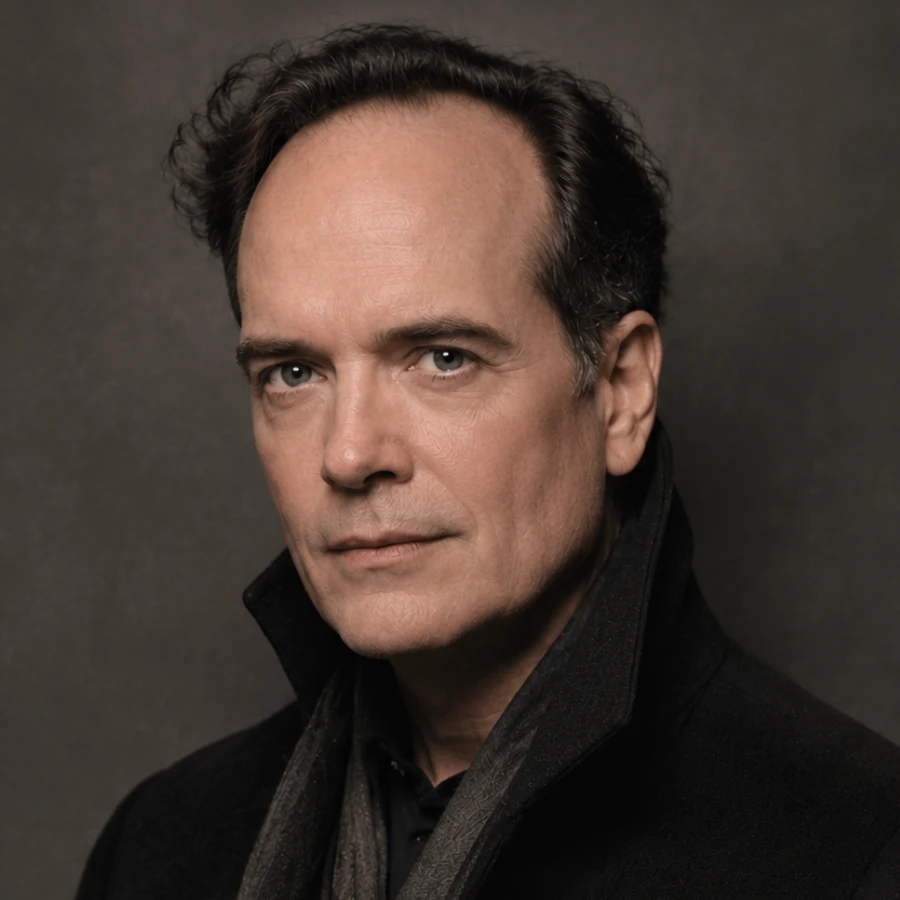
Jefferson Mays

*

The Company
(
)
(
)
Pronouns:
he/him

Jefferson Mays is a Tony Award-winning actor whose remarkable versatility has made him one of the American theatre's most celebrated performers. He won the Tony Award for Best Actor in a Play for I Am My Own Wife, in which he portrayed more than 40 characters, and received additional Tony nominations for A Gentleman's Guide to Love and Murder and Oslo. His Broadway credits also include The Music Man, The Front Page, and The Best Man. Mays previously inhabited the world of Charles Dickens in a solo adaptation of A Christmas Carol, portraying more than 50 characters. A Tale of Two Cities marks an imagined return to Dickens's universe, exploring the transformative possibilities of a single performer bringing an entire world to life.

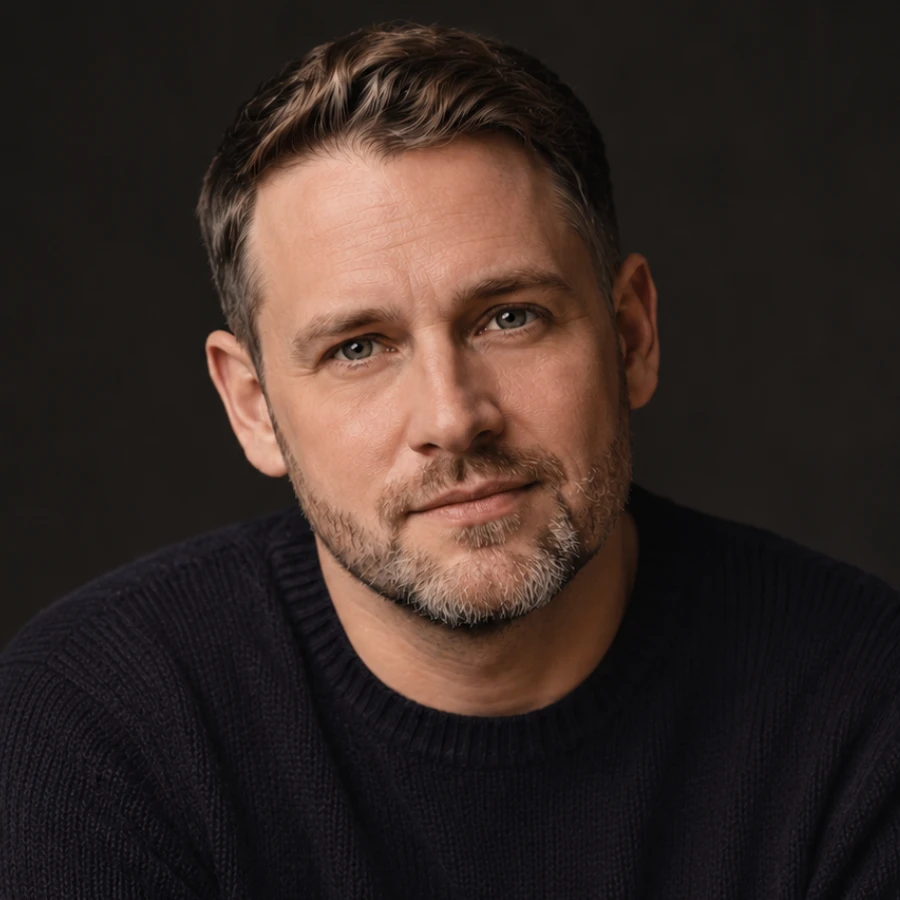
David Pittu

*

u/s The Company
(
)
(
)
Pronouns:
he/him

David Pittu is a two-time Tony Award-nominated actor, writer, and director whose career spans Broadway, Off-Broadway, television, and film. He received Tony nominations for his performances in LoveMusik and Is He Dead? and has appeared in numerous classical and contemporary theatrical productions. Known for his versatility, distinctive character work, and command of language, Pittu brings a wealth of experience to this imagined production of A Tale of Two Cities, standing ready to inhabit the many characters of Dickens's revolutionary epic.

Meet the Team

Michael Arden

*

Stage Adaptation and Direction
(
)
Pronouns:
he/him

MICHAEL ARDEN is a Tony Award-winning director and acclaimed actor whose work is distinguished by imaginative theatrical storytelling and a deeply human approach to classic material. He received the Tony Award for Best Direction of a Musical for the 2023 Broadway revival of Parade, following Tony nominations for his direction of Spring Awakening and Once on This Island. His work frequently explores the relationship between theatrical form, memory, and collective experience. For this fictional adaptation of A Tale of Two Cities, Arden reimagines Dickens's epic narrative as an intimate encounter between one performer and an entire civilization.

Aaron Dessner

*

Music Supervision & Arrangements
(
)
Pronouns:
he/him

Aaron Dessner is a Grammy Award-winning musician, songwriter, and producer, best known as a founding member of The National. His work includes collaborations with Taylor Swift on folklore and evermore, as well as projects with Bon Iver, Sharon Van Etten, and numerous other artists. He is a co-founder of the international music festival and collaborative platform PEOPLE. For A Tale of Two Cities, Dessner serves as music supervisor and arranger, adapting The National's original score for a live chamber ensemble and prerecorded accompaniment.

Blackwell Group

*

General Management
(
)
Pronouns:

BLACKWELL THEATRICAL GROUP is a fictional New York-based theatrical management company specializing in Broadway and Off-Broadway productions, limited engagements, and artist-driven theatrical events. Founded in 2008, the company provides financial administration, contractual oversight, production planning, and general management services. Its portfolio includes new plays, literary adaptations, and intimate theatrical productions featuring distinguished performers. Blackwell is proud to support A Tale of Two Cities and its commitment to ambitious storytelling on a human scale.

Ann Hould-Ward

*

Costume Design
(
)
Pronouns:
she/her

ANN HOULD-WARD (Costume Design) is a Tony Award-winning costume designer whose distinguished career encompasses Broadway, opera, dance, and international theatrical productions. She received the Tony Award for Best Costume Design for Disney's Beauty and the Beast, and her extensive credits include Into the Woods, Sunday in the Park with George, and The Color Purple. Her designs are celebrated for their richly detailed characterization and sensitivity to period and dramatic context. For this imagined production, Hould-Ward creates a versatile costume vocabulary that allows one actor to move fluidly among the many lives inhabiting Dickens's novel.

Dane Laffrey

*

Scenic Design
(
)
Pronouns:
he/him

DANE LAFFREY is a New York-based scenic and costume designer whose work spans Broadway, Off-Broadway, opera, and international theatre. His Broadway credits include Once on This Island, Maybe Happy Ending, and A Christmas Carol. Known for creating expressive theatrical environments that place storytelling at the center of design, Laffrey approaches space as an active participant in performance. For this fictional production, his scenic concept transforms a single stage into the streets, courtrooms, prisons, and private rooms of revolutionary London and Paris.

The National

*

Original Music
(
)
Pronouns:

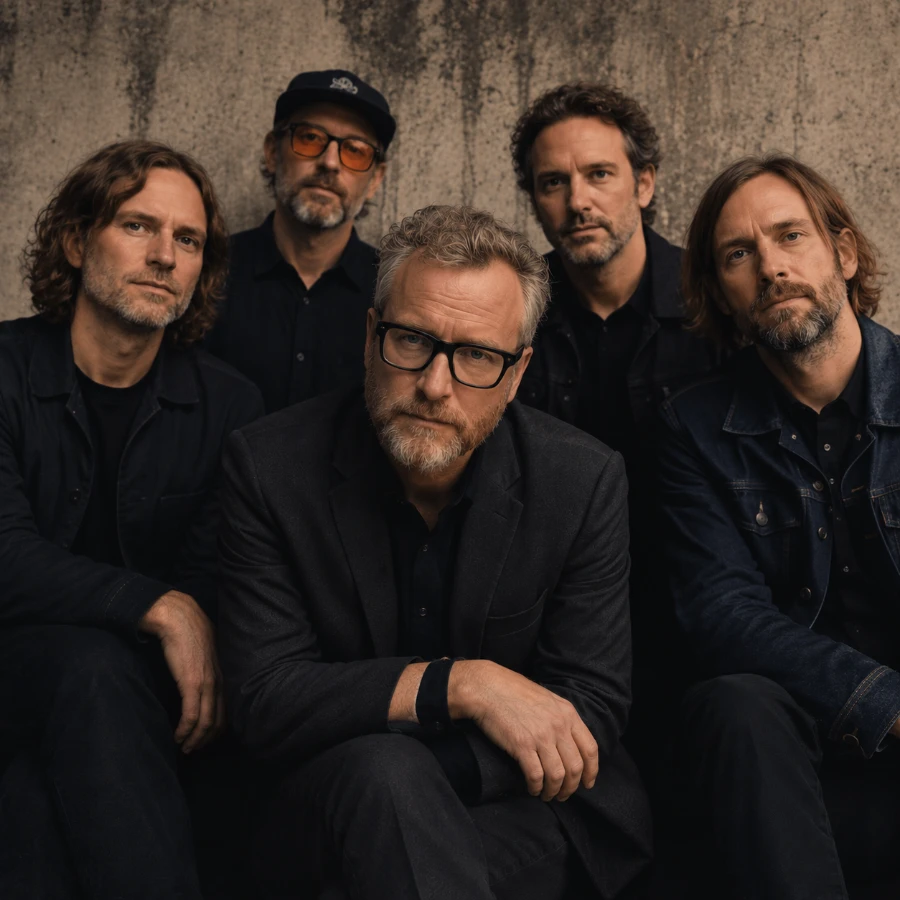
THE NATIONAL is an American rock band formed in Cincinnati, Ohio, and known for its atmospheric arrangements, emotionally incisive songwriting, and distinctive musical textures. The group consists of Matt Berninger, Aaron Dessner, Bryce Dessner, Scott Devendorf, and Bryan Devendorf. Their acclaimed recordings include Boxer, High Violet, Trouble Will Find Me, Sleep Well Beast, and First Two Pages of Frankenstein. Their work frequently incorporates orchestral instrumentation, minimalist repetition, and haunting melodic structures. In this imagined theatrical collaboration, The National provides an original instrumental score tracing the emotional and political turbulence of Dickens's revolutionary world.

The Telsey Office

*

Casting
(
)
Pronouns:

THE TELSEY OFFICE is a New York-based casting office whose work spans Broadway, Off-Broadway, film, television, and commercial productions. Founded by Bernard Telsey, the office has helped assemble casts for some of the most celebrated theatrical productions of recent decades, including Hamilton, Wicked, and Rent. Known for its collaborative approach to casting and commitment to discovering exceptional performers, The Telsey Office has played an influential role in contemporary American theatre.

Amara Okafor

*

Music Director
(
)
Pronouns:
she/her

Amara Okafor is a Nigerian pianist, composer, and music director whose work spans theatre, contemporary classical music, and experimental performance. Born in Lagos, she studied piano and composition before pursuing a career in musical collaboration and theatrical storytelling. Her work combines classical technique with electronic soundscapes, improvisation, and West African musical influences. A Tale of Two Cities marks her Broadway debut, where she leads the production's four-piece live ensemble.

Lorenzo Pisoni

*

Movement Direction
(
)
Pronouns:
he/him

LORENZO PISONI is an actor, choreographer, and movement artist whose career bridges physical theatre, circus, and Broadway performance. Raised in a family of circus performers, he developed a distinctive physical vocabulary that combines theatrical precision with an instinctive understanding of storytelling through movement. His Broadway appearances include Equus and Henry IV, and his solo work Humor Abuse drew upon his childhood in the Pickle Family Circus. For this imagined production, Pisoni develops a physical language through which a single actor can suggest an entire society of sharply differentiated characters.

Northlight Theatrical Productions

*

Producer
(
)
Pronouns:

NORTHLIGHT THEATRICAL PRODUCTIONS (Producer) is a fictional New York-based theatrical production company dedicated to developing and presenting artist-driven works for the commercial stage. With a particular interest in literary adaptations, innovative revivals, and intimate productions of extraordinary scope, Northlight seeks to bring familiar stories to audiences through unexpected theatrical perspectives. A Tale of Two Cities continues the company's imagined commitment to ambitious work that places the performer and the audience's imagination at the center of the theatrical experience.

North & Public Relations

*

Press Representative
(
)
Pronouns:

NORTH & WEST PUBLIC RELATIONS is a fictional entertainment publicity agency representing theatrical productions, performing artists, and cultural institutions. Its work encompasses Broadway and Off-Broadway campaigns, opening-night events, media relations, and audience engagement. The agency has developed publicity campaigns for new theatrical works, classic revivals, and limited-engagement productions. North & West is pleased to represent A Tale of Two Cities, a production that proves even the most familiar stories can still make headlines.

Aaron Rhyne

*

Projection Design
(
)
Pronouns:
he/him

AARON RHYNE is an award-winning projection and video designer whose work includes Broadway musicals, plays, concerts, and immersive theatrical experiences. His Broadway credits include Anastasia, A Gentleman's Guide to Love and Murder, and The Sound of Music. Rhyne's work combines visual storytelling with innovative theatrical technology, creating environments that shift between the tangible and the imagined. For this fictional production, his projections evoke the changing architecture, political imagery, and collective memory of eighteenth-century London and Paris.

Meridian Production Services

*

Production Management
(
)
Pronouns:

MERIDIAN PRODUCTION SERVICES is a fictional theatrical production management firm providing technical supervision, production coordination, and logistical support for commercial and nonprofit theatre. With experience in scenic automation, multimedia integration, and complex repertory environments, Meridian specializes in translating ambitious creative concepts into practical stage solutions. For A Tale of Two Cities, the team oversees the technical systems that transform a single performance space into two cities, numerous locations, and nearly two decades of revolutionary history.

Ben Stanton

*

Lighting Design
(
)
Pronouns:
he/him

BEN STANTON is an acclaimed theatrical lighting designer whose work includes Broadway, Off-Broadway, and international productions. His credits include Fun Home, Spring Awakening, The Notebook, and Maybe Happy Ending. Stanton's work is known for its emotional precision and ability to define space, atmosphere, and the passage of time through light. In this fictional production, his lighting design distinguishes the restrained world of Georgian London from the volatile streets of revolutionary Paris, allowing the story's many locations and characters to emerge from a constantly transforming visual landscape.

Darron West

*

Sound Design
(
)
Pronouns:
he/him

DARRON L WEST is a Tony Award-winning sound designer and composer whose work spans theatre, dance, and multimedia performance. His Broadway credits include Peter and the Starcatcher, for which he received the Tony Award for Best Sound Design of a Play, and The Merchant of Venice. His work is recognized for its sophisticated integration of sound, music, and dramatic storytelling. For this fictional adaptation, West creates an immersive sonic environment in which the intimacy of a whispered confession can give way to the overwhelming force of a city in revolution, integrating an imagined original score by The National.

Eleanor Whitcomb

*

Dramaturg
(
)
Pronouns:
she/her

ELEANOR WHITCOMB is a New York-based dramaturg, literary consultant, and theatre historian specializing in adaptations of nineteenth-century literature. Her work explores the intersection of historical research, dramatic structure, and contemporary theatrical storytelling. She has collaborated with regional theatres and independent companies on productions inspired by the works of Dickens, Austen, and the Brontë sisters. For A Tale of Two Cities, Whitcomb provides historical and literary research, helping illuminate the political upheaval of the French Revolution and the intimate human stories at the heart of Dickens's novel.

Media

No items found.
2021 National Touring Cast

Pre-Show Snack or
Post-Show Dinner?

Don’t let the evening end when the curtain comes down. With The Marquee Local, you can find the perfect place for a pre-show snack, an evening meal, or a post-show cocktail. Enjoy exclusive deals from our local partners as you catch up, discuss the show, and create memories to last a lifetime.

Grab a Bite
Pre-show or post-show, our local partners have your dining needs covered
Raise a Glass
Settle into that post-show glow with a stellar drink in hand

Grab a Bite

There are currently no restaurants to peruse.

Raise a Glass

There are currently no bars to peruse.

While You Wait

With the help of our friends at Theatrely.com, Marquee Digital has you covered with exclusive content while you wait for the curtain to rise.

An Incredibly Strong Ensemble With HERE THERE ARE BLUEBERRIES — Review
Joey Sims
November 10, 2026

Here There Are Blueberries begins, not too convincingly, as a detective story. Tectonic Theater Project’s investigative piece, premiered at La Jolla Playhouse in 2022 and now playing a limited Broadway run at the Barrymore Theatre, lives unnaturally in that mode of storytelling for a time before opening out into more intriguing, dramatically coherent questions. Once it reaches those larger inquiries, Blueberries does prove a stirring piece of theater—if not always a natural fit for a Broadway stage. 

To begin, a photo album has landed on the desk of historian Rebecca Erbelding (Elizabeth Shahlmann), an archivist at the National Holocaust Museum in Washington, D.C. The album depicts daily life in and around Auschwitz from the perspective of the camp’s military leaders, their families, and various staff. These  photos are frightening in their normalcy: parties, days off lounging in beach chairs, children playing in front yards. Just outside the frame, a mass extermination event goes unacknowledged. 

The album in question was first discovered in 2006, then made public by the museum two years later. It earned global headlines and renewed a push to track down and prosecute leading Nazi commanders depicted in the photos. Following years of interviews and extensive research into the album and its fallout, the acclaimed company Tectonic (best known for The Laramie Project) debuted Here There Are Blueberries in 2022 at La Jolla, followed by an off-Broadway production at New York Theatre Workshop in 2024. The text is by Tectonic artistic director Moisés Kaufman and author Amanda Gronich; Kaufman directs this Broadway staging, as on previous productions.

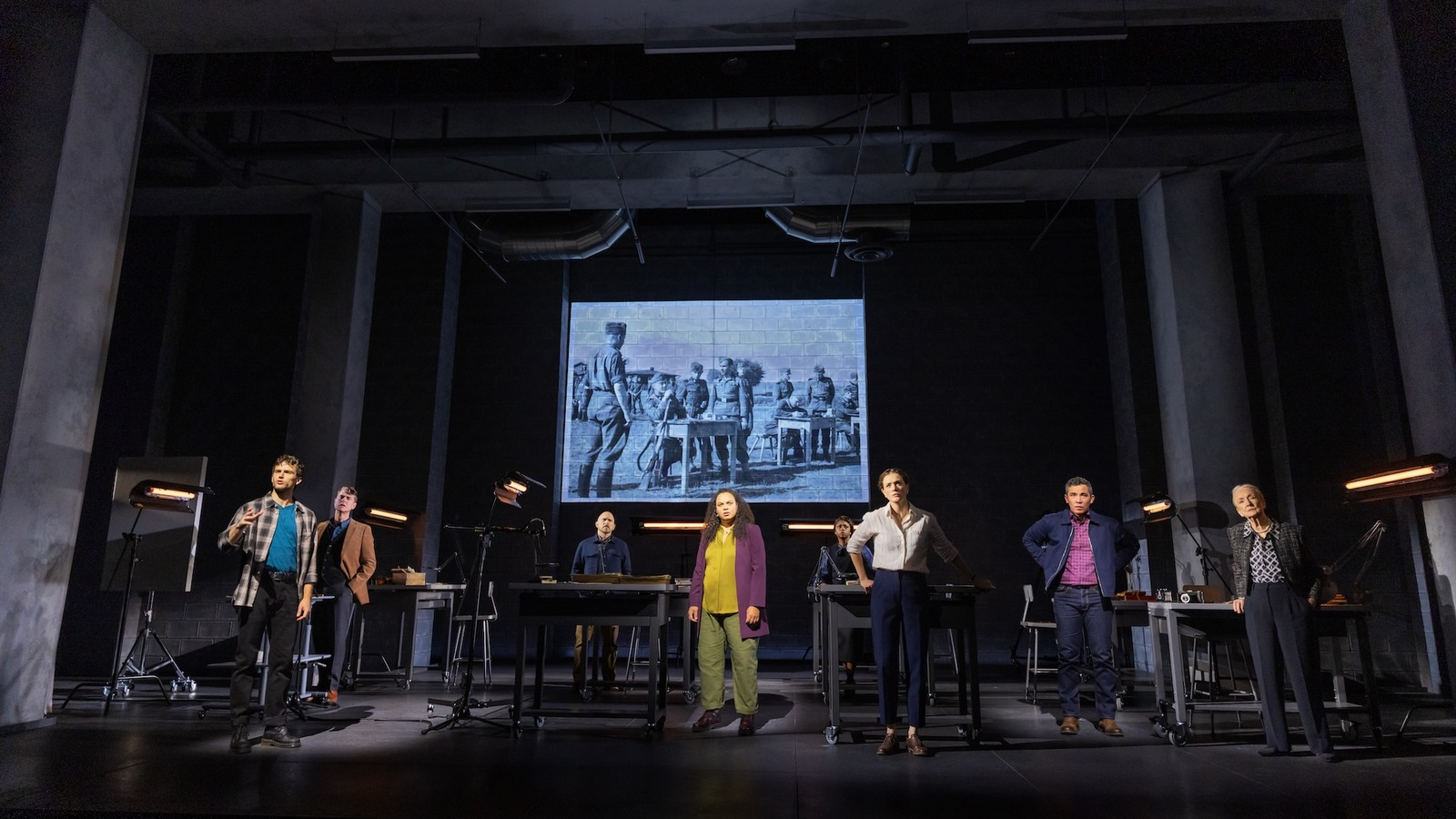
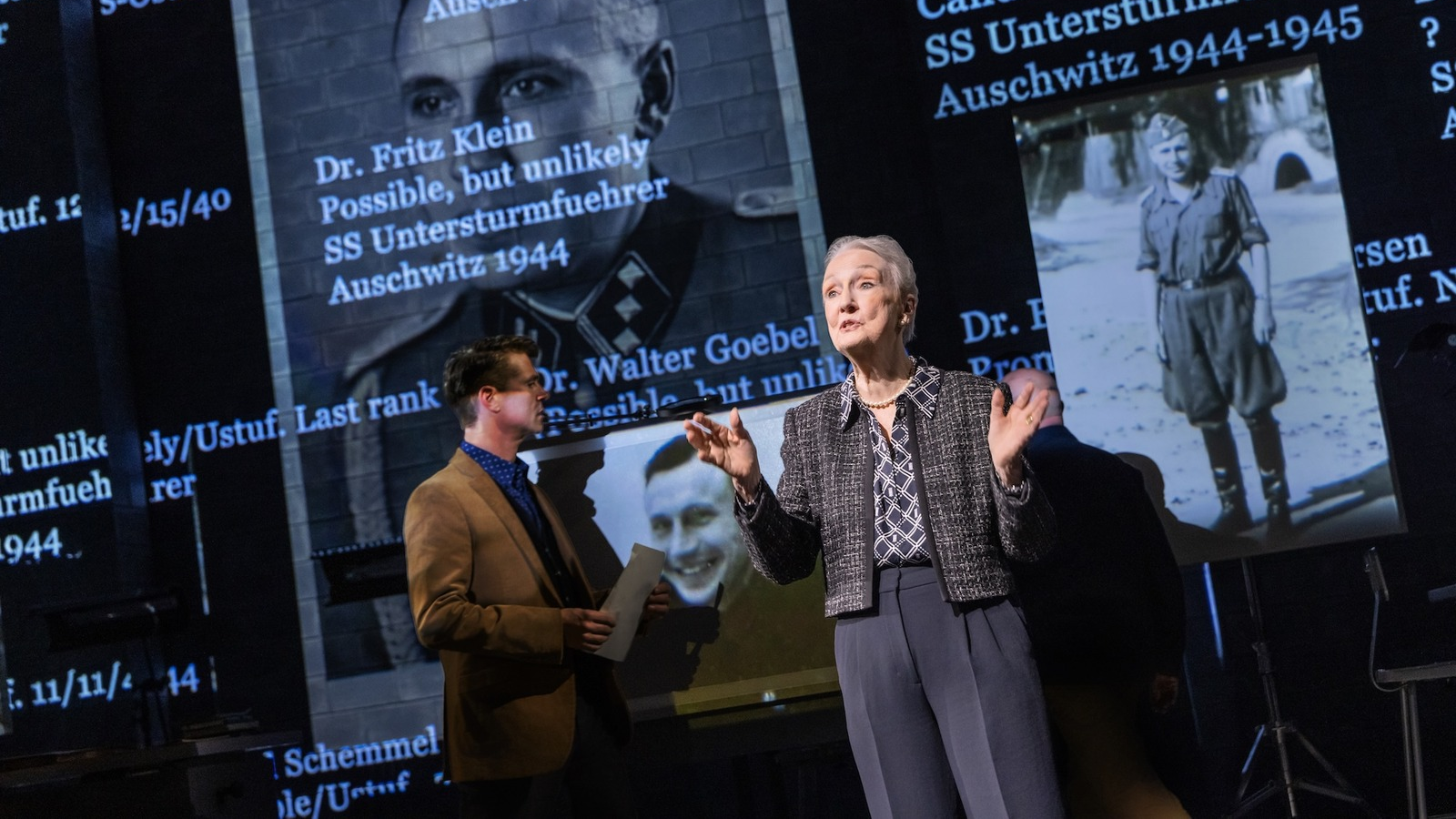
The play’s early scenes focus on Erbelding investigating the album’s content. Alongside a staff of researchers she pieces together the identities of those pictured, the locations of the shots and the time period covered in the photographs. The text by Kaufman and Gronich tends to frame each new discovery as a shocking revelation, many gravely intoned by either Erbelding herself or other staffers. Under Kaufman’s direction, the delivery feels stagy, lines thrown at us with vocal underling and italicization to highlight the significance. 

The impulse to inject some narrative drama into this research process is understandable, but it all feels a bit forced. Much of what we’re learning feels routine to any historical research process, and it is hardly detective work. The owner of the album, SS Commander Karl Hocker, is identified straightforwardly by photo captions; a resort nearby Auschwitz named Solahütte is located by reviewing maps and nearby geography. It would be enough, I think, to here simply depict a set of smart and competent minds performing their jobs with skill. That can be thrilling all on its own.
__wf_reserved_inherit
Photo: Matthew Murphy

The same approach could have better served scenes where Erbelding and her various superiors (portrayed by Kathleen Chalfant, Montego Glover and Brandon Flynn) debate the ethical questions posed by releasing and exhibiting the photos. Would it risk humanizing the perpetrators of mass murder? Does it fit the mission of the museum? These are intriguing questions, and they do take on a fuller life later in the play. But again, the performers are pushed to play these debates as tense, even deeply personal. I was not totally convinced—would professional researchers talk to each other this way? 

But there is more still to unfold in Kaufman’s elegantly austere staging, which begins as lecture-style but gradually finds some warmth. Scenes focused on unpacking the photos themselves play awkwardly on the larger Barrymore stage—even seated in the orchestra, I felt at a great distance from the images, which projection designer David Bengali mostly places on the upstage wall. 

Yet this strong ensemble of performers do generate a feeling of direct connection with the audience, close at times to intimacy. The most successful in this regard is the esteemable Kathleen Chalfant, a performer of rare grace who always feels like she is speaking directly to you. Michelle Beck is similarly strong, while Scott Barrow does careful work in multiple historical roles while steering clear of direct impersonation. Tony Award winner Michael Ceveris is also excellent, most especially as a descendant of Nazi officers struggling with his family inheritance.

That question of inheritance is powerfully explored in a scene centering Rainer Höss, the son of Auschwitz commander Rudolph Höss and a man gripped by violent and destructive urges that he fears live inexorably in his blood. The scene includes a challenging monologue, probably the play’s most daring, that Flynn plays with careful restraint. (His scene partner Conrad Ricamora is unfortunately flat as Tilman Taube.)

Höss’s monologue leads us into the strongest and most resonant theme of Blueberries, one that pushes its audience to look inward: how different are any of us, truly, from the people depicted in this album? The normalcy of the photos drives the point home. Are we capable, under the right circumstances, of similar barbarity? 

“We have to look for ourselves,” concludes Erbelding, “in every picture.” 

She means not just the officers, but also their families, who knew everything; or the staffers, many of them young women, who knew everything. She means not just the direct perpetrators—though yes, that could be us—but also the accessories, the ones who carried on their lives while ignoring all that lived outside their personal frame.

In terms of contemporary resonance, the idea is left amorphous, a notion to be chewed on without specificity. I reflected personally, on the devastation in Gaza; I also thought of the daily violence inflicted by ICE across the United States. I thought of our smaller and daily capacities for cruelty, seen and inflicted by all of us in daily capitalist life, in ways both very big and minutely small. The expansiveness of the final question has frustrated some critics, and reasonably so. But for me, it feels right for this particular story, centered on this particular album. Evil is everywhere, and it does not have a special face. It is in you, and me, and all of us.

here There Are Blueberries is now in performance at the Barrymore Theatre on West 47th Street in New York City. For tickets and more information, visit here.
An Incredibly Strong Ensemble With HERE THERE ARE BLUEBERRIES — Review
Joey Sims
November 10, 2026

Here There Are Blueberries begins, not too convincingly, as a detective story. Tectonic Theater Project’s investigative piece, premiered at La Jolla Playhouse in 2022 and now playing a limited Broadway run at the Barrymore Theatre, lives unnaturally in that mode of storytelling for a time before opening out into more intriguing, dramatically coherent questions. Once it reaches those larger inquiries, Blueberries does prove a stirring piece of theater—if not always a natural fit for a Broadway stage. 

To begin, a photo album has landed on the desk of historian Rebecca Erbelding (Elizabeth Shahlmann), an archivist at the National Holocaust Museum in Washington, D.C. The album depicts daily life in and around Auschwitz from the perspective of the camp’s military leaders, their families, and various staff. These  photos are frightening in their normalcy: parties, days off lounging in beach chairs, children playing in front yards. Just outside the frame, a mass extermination event goes unacknowledged. 

The album in question was first discovered in 2006, then made public by the museum two years later. It earned global headlines and renewed a push to track down and prosecute leading Nazi commanders depicted in the photos. Following years of interviews and extensive research into the album and its fallout, the acclaimed company Tectonic (best known for The Laramie Project) debuted Here There Are Blueberries in 2022 at La Jolla, followed by an off-Broadway production at New York Theatre Workshop in 2024. The text is by Tectonic artistic director Moisés Kaufman and author Amanda Gronich; Kaufman directs this Broadway staging, as on previous productions.

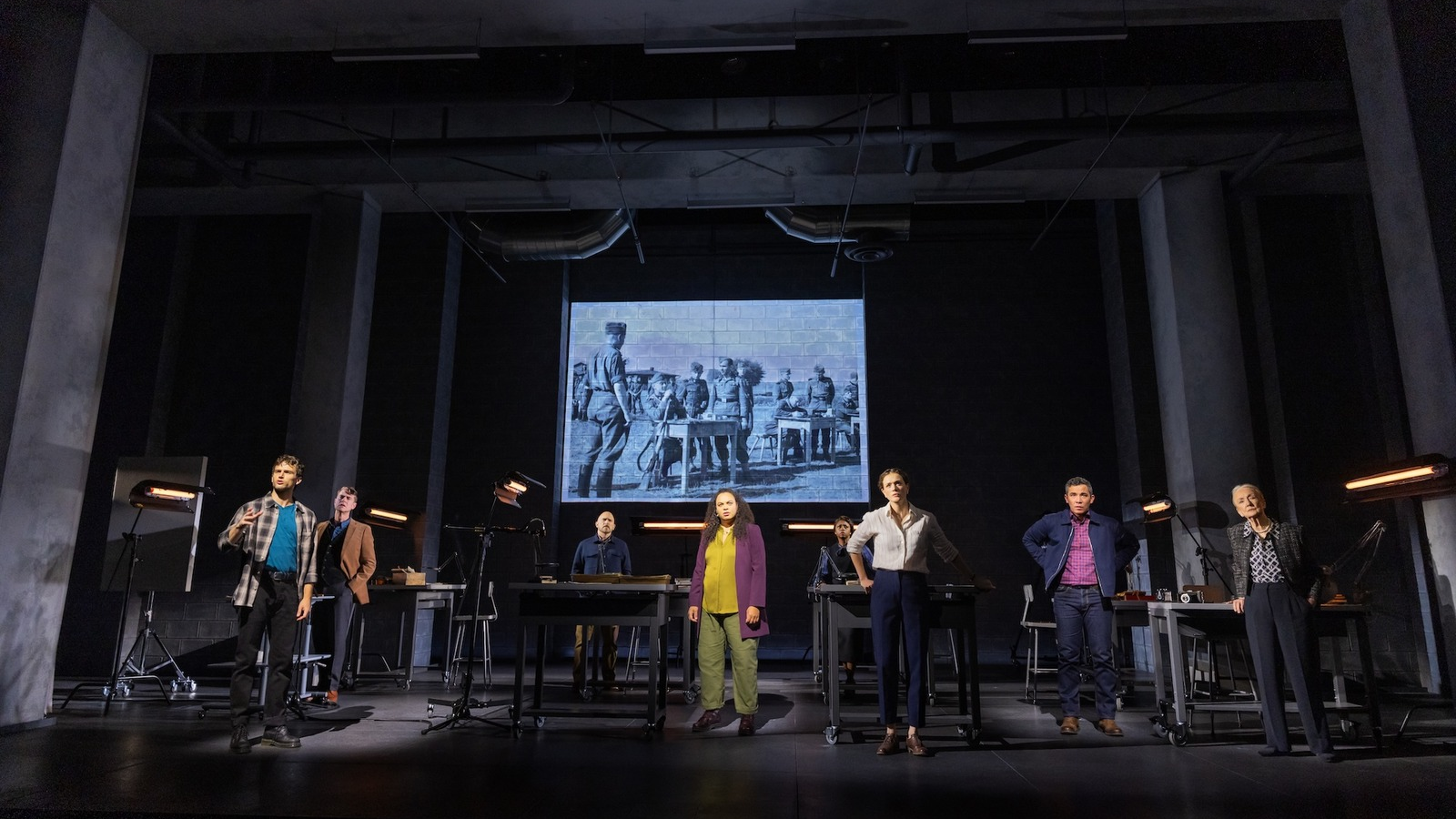
The play’s early scenes focus on Erbelding investigating the album’s content. Alongside a staff of researchers she pieces together the identities of those pictured, the locations of the shots and the time period covered in the photographs. The text by Kaufman and Gronich tends to frame each new discovery as a shocking revelation, many gravely intoned by either Erbelding herself or other staffers. Under Kaufman’s direction, the delivery feels stagy, lines thrown at us with vocal underling and italicization to highlight the significance. 

The impulse to inject some narrative drama into this research process is understandable, but it all feels a bit forced. Much of what we’re learning feels routine to any historical research process, and it is hardly detective work. The owner of the album, SS Commander Karl Hocker, is identified straightforwardly by photo captions; a resort nearby Auschwitz named Solahütte is located by reviewing maps and nearby geography. It would be enough, I think, to here simply depict a set of smart and competent minds performing their jobs with skill. That can be thrilling all on its own.

__wf_reserved_inherit
Photo: Matthew Murphy

The same approach could have better served scenes where Erbelding and her various superiors (portrayed by Kathleen Chalfant, Montego Glover and Brandon Flynn) debate the ethical questions posed by releasing and exhibiting the photos. Would it risk humanizing the perpetrators of mass murder? Does it fit the mission of the museum? These are intriguing questions, and they do take on a fuller life later in the play. But again, the performers are pushed to play these debates as tense, even deeply personal. I was not totally convinced—would professional researchers talk to each other this way? 

But there is more still to unfold in Kaufman’s elegantly austere staging, which begins as lecture-style but gradually finds some warmth. Scenes focused on unpacking the photos themselves play awkwardly on the larger Barrymore stage—even seated in the orchestra, I felt at a great distance from the images, which projection designer David Bengali mostly places on the upstage wall. 

Yet this strong ensemble of performers do generate a feeling of direct connection with the audience, close at times to intimacy. The most successful in this regard is the esteemable Kathleen Chalfant, a performer of rare grace who always feels like she is speaking directly to you. Michelle Beck is similarly strong, while Scott Barrow does careful work in multiple historical roles while steering clear of direct impersonation. Tony Award winner Michael Ceveris is also excellent, most especially as a descendant of Nazi officers struggling with his family inheritance.

That question of inheritance is powerfully explored in a scene centering Rainer Höss, the son of Auschwitz commander Rudolph Höss and a man gripped by violent and destructive urges that he fears live inexorably in his blood. The scene includes a challenging monologue, probably the play’s most daring, that Flynn plays with careful restraint. (His scene partner Conrad Ricamora is unfortunately flat as Tilman Taube.)

Höss’s monologue leads us into the strongest and most resonant theme of Blueberries, one that pushes its audience to look inward: how different are any of us, truly, from the people depicted in this album? The normalcy of the photos drives the point home. Are we capable, under the right circumstances, of similar barbarity? 

“We have to look for ourselves,” concludes Erbelding, “in every picture.” 

She means not just the officers, but also their families, who knew everything; or the staffers, many of them young women, who knew everything. She means not just the direct perpetrators—though yes, that could be us—but also the accessories, the ones who carried on their lives while ignoring all that lived outside their personal frame.

In terms of contemporary resonance, the idea is left amorphous, a notion to be chewed on without specificity. I reflected personally, on the devastation in Gaza; I also thought of the daily violence inflicted by ICE across the United States. I thought of our smaller and daily capacities for cruelty, seen and inflicted by all of us in daily capitalist life, in ways both very big and minutely small. The expansiveness of the final question has frustrated some critics, and reasonably so. But for me, it feels right for this particular story, centered on this particular album. Evil is everywhere, and it does not have a special face. It is in you, and me, and all of us.

here There Are Blueberries is now in performance at the Barrymore Theatre on West 47th Street in New York City. For tickets and more information, visit here.
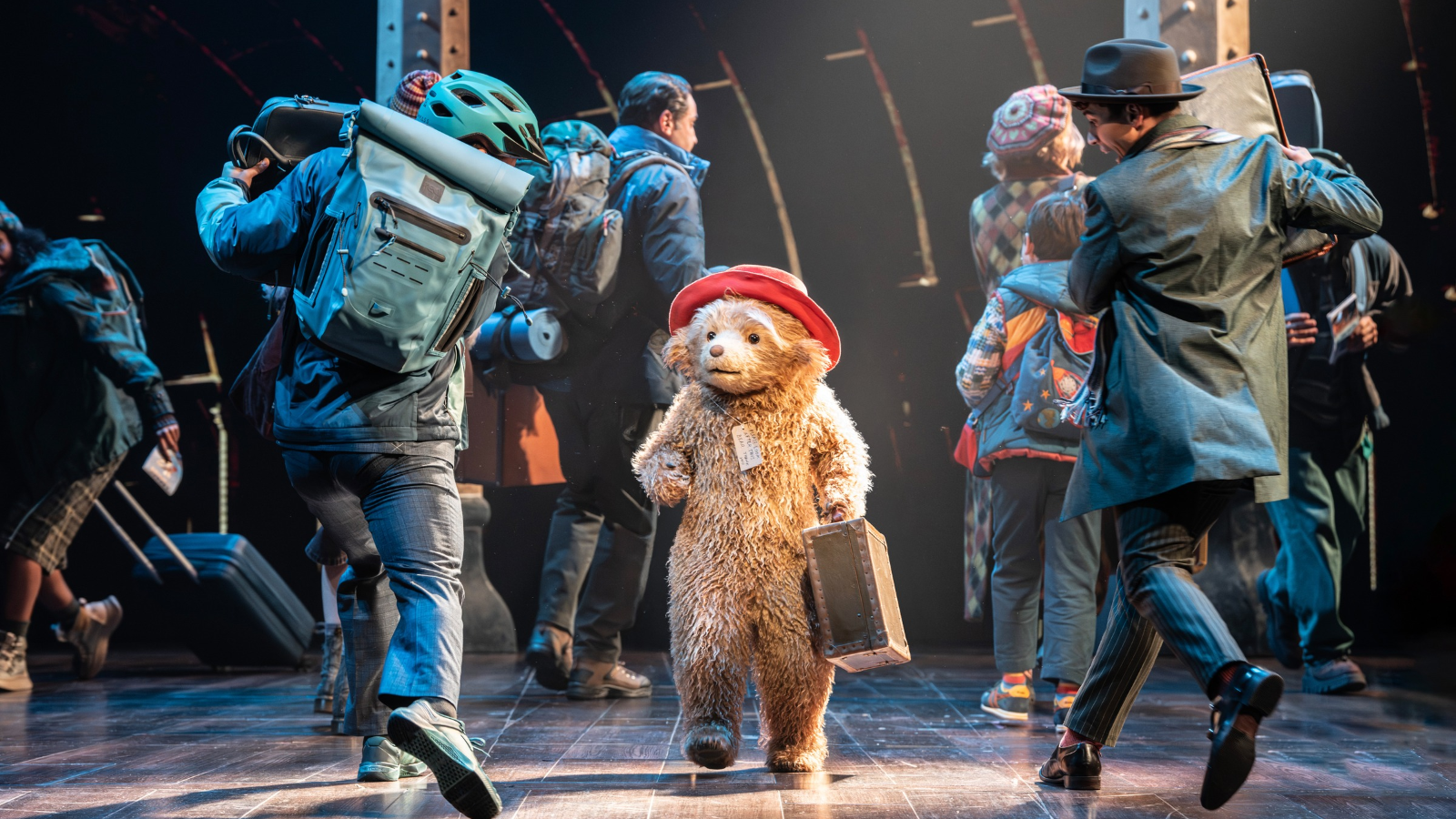
PADDINGTON Announces Broadway Cast And We Are Freaking Out
Kobi Kassal
November 9, 2026

That loveable British bear is making his way to Broadway with a true all-star cast of Broadway favorites and newcomers alike.

The company will be led by Kelvin Dukes (“America’s Got Talent”) as Tony, Drew Gehling (Waitress) as Mr. Brown, Allison Guinn (Operation Mincemeat) as Lady Sloane, three-time Emmy Award winner Tony Hale (“Veep”) as Mr. Curry, Olivier Award winner James Hameed (Paddington The Musical Original West End Cast) as Young Man/Paddington (Voice & Remote Puppetry), J. Quinton Johnson (Hamilton) as Grant, Leslie Rodriguez Kritzer (The Fantasticks) as Millicent Clyde, Zonya Love (The Color Purple) as Tanya, Tony Award winner Jessie Mueller (Waitress) as Mrs. Brown, Serena Parrish (Don’t Say Good Luck) as Judy Brown, Olivier Award winner Arti Shah (Paddington The Musical Original West End Cast) as Paddington (Onstage Performer), Tony Award winner Karen Ziemba (Contact) as Mrs. Bird, and Drama Desk Award nominee Chip Zien (Into the Woods Original Broadway Cast) as Mr. Gruber. The full cast will be announced shortly. 

“We’ve been completely blown away by the extraordinary artists we’ve met throughout the casting process, and by the warmth and enthusiasm with which everyone has welcomed Paddington to Broadway. We really do have a dream company. These are some of the most talented performers working today, all choosing to spend their time and considerable gifts on this funny, joyful and deeply life-affirming new musical. We couldn’t feel luckier,” said the show’s producers. 

Paddington features musical supervision, orchestrations and arrangements by Olivier Award nominee Matt Brind; choreography by Tony and Olivier Award nominee Ellen Kane; scenic design by Olivier Award winner and Tony Award nominee Tom Pye; costume design by Tony and Olivier Award winner Gabriella Slade; Paddington and puppet design by Olivier Award winner Tahra Zafar; lighting design by Tony and Olivier Award winner Neil Austin; sound design by Tony and Olivier Award winner Gareth Owen; video design and animation by Olivier Award winner Ash J Woodward; hair, wig and makeup design by Campbell Young Associates; casting by Jim Carnahan Casting, Jim Carnahan, CSA, and Jason Thinger, CSA; Paddington Casting Consultant Annabelle Davis; Bear Physicality and Additional Puppetry by Audrey Brisson; and Aubrey Smalls is Access Coordinator. 

Plus, Mastercard and Capital One have joined the production as its Official Payment Services Sponsor and Official Retail Banking Services Sponsor. Through the partnership, Mastercard and Capital One will create new ways for eligible cardholders to experience Paddington the Musical both on and off the stage, including special packages, opening night red carpet access, and pre-show tea party and post-show talkback experiences.

The smash hit, seven-time Olivier Award-winning Best New Musical will begin performances Tuesday, March 30, 2027, and officially open Sunday, April 18, 2027 at Broadway’s Al Hirschfeld Theatre (302 West 45th Street). Tickets are on sale here.

Theatrely News
EXCLUSIVE: Watch A Clip From THEATER CAMP Starring Ben Platt, Noah Galvin, and Molly Gordon
Theatrely News
READ: An Excerpt From Sean Hayes Debut YA Novel TIME OUT
Theatrely News
"Reframing the COVID-19 Pandemic Through a Stage Manager’s Eyes"
EXCLUSIVE: Watch A Clip From THEATER CAMP Starring Ben Platt, Noah Galvin, and Molly Gordon
By: Maia Penzer
14 July 2023

Finally, summer has arrived, which can only mean one thing: it's time for camp! Theater Camp, that is. Theatrely has a sneak peak at the new film which hits select theaters today. 

The new original comedy starring Tony Award winner Ben Platt and Molly Gordon we guarantee will have you laughing non-stop. The AdirondACTS, a run-down theater camp in upstate New York, is attended by theater-loving children who must work hard to keep their beloved theater camp afloat after the founder, Joan, falls into a coma. 

The film stars Ben Platt and Molly Gordon as Amos Klobuchar and Rebecca-Diane, respectively, as well as Noah Galvin as Glenn Wintrop, Jimmy Tatro as Troy Rubinsky, Patti Harrison as Caroline Krauss, Nathan Lee Graham as Clive DeWitt, Ayo Edebiri as Janet Walch, Owen Thiele as Gigi Charbonier, Caroline Aaron as Rita Cohen, Amy Sedaris as Joan Rubinsky, and Alan Kim as Alan Park. 

Theater Camp was directed by Molly Gordon and Nick Lieberman and written by Noah Galvin, Molly Gordon, Nick Lieberman & Ben Platt. Music is by James McAlister and Mark Sonnenblick. On January 21, 2023, Theater Camp had its world premiere at the Sundance Film Festival.

You can purchase tickets to the new film from our friends at Hollywood.com here.

‍

READ: An Excerpt From Sean Hayes Debut YA Novel TIME OUT
By: Kobi Kassal
29 May 2023

Actor Sean Hayes is what we in the biz call booked and blessed. On top of his Tony-nominated performance as Oscar Levant in Good Night, Oscar, Hayes has partnered with Todd Milliner and Carlyn Greenwald for the release of their new YA novel Time Out. 

Heralded by many as Heartstopper meets Friday Night Lights, Time Out follows hometown basketball hero Barclay Elliot who decides to use a pep rally to come out to his school. When the response is not what he had hoped and the hostility continually growing, he turns to his best friend Amy who brings him to her voting rights group at school. There he finds Christopher and… you will just have to grab a copy and find out what happens next. Luckily for you, Time Out hits shelves on May 30 and to hold you over until then we have a special except from the book just for Theatrely:

The good thing about not being on the team the past two weeks has been that I’ve had time to start picking up shifts again at Beau’s diner and save up a little for college now that my scholarship dreams are over.

     The bad part is it’s the perfect place to see how my actions at the pep rally have rotted the townspeople’s brains too.

     During Amy’s very intense musical theater phase in middle school, her parents took her to New York City. And of course she came back home buzzing about Broadway and how beautiful the piss smell was and everything artsy people say about New York. But she also vividly described some diner she waited three hours to get into where the waitstaff would all perform songs for the customers as a way to practice for auditions. The regulars would have favorite staff members and stan them the way Amy stans all her emo musicians.

     Working at Beau’s used to feel kind of like that, like I was part of a performance team I didn’t know I signed up for. The job started off pretty basic over the summer—I wanted to save up for basketball supplies, and Amy worked there and said it was boring ever since her e-girl coworker friend graduated. But I couldn’t get through a single lunch rush table without someone calling me over and wanting the inside scoop on the Wildcats and how we were preparing for the home opener, wanting me to sign an article in the paper or take a photo. Every friendly face just made the resolve grow inside me. People love and support the Wildcats; they would do the same for me.

     Yeah, right.

     Now just like school, customers have been glaring at me, making comments about letting everyone down, about being selfish, about my actions being “unfortunate,” and the tips have been essentially nonexistent. The Wildcats have been obliterated in half their games since I quit, carrying a 2–3 record when last year we were 5–0, and the comments make my feet feel like lead weights I have to drag through every shift.

     Today is no different. It’s Thursday, the usual dinner rush at Beau’s, and I try to stay focused on the stress of balancing seven milkshakes on one platter. A group of regulars, some construction workers, keep loudly wondering why I won’t come back to the team while I refuse proper eye contact.

     One of the guys looks up at me as I drop the bill off. “So, what’s the deal? Does being queer keep ya from physically being able to play?”

     They all snicker as they pull out crumpled bills. I stuff my hands into my pockets, holding my tongue.

     When they leave, I hold my breath as I take their bill.

     Sure enough, no tip.

     “What the fuck?” I mutter under my breath.

     “Language,” Amy says as she glides past me, imitating the way Richard says it to her every shift, and adds, “even though they are dicks.” At least Amy’s been ranting about it every free chance she gets. It was one thing when the student body was being shitty about me leaving the team, but the town being like this is even more infuriating. She doesn’t understand how these fully grown adults can really care that much about high school basketball and thinks they need a new fucking hobby. I finally agree with her.

     [She’s wearing red lipstick to go with her raccoon-adjacent eyeliner as she rushes off to prepare milkshakes for a pack of middle schoolers. I catch her mid–death glare as all three of the kids rotate in their chairs, making the old things squeal. My anger fades a bit as I can’t help but chuckle; Amy’s pissed-off reaction to Richard telling her to smile more was said raccoon makeup, and her tolerance for buffoonery has been at a negative five to start and declining fast.

     I rest my arms on the counter and try not to look as exhausted as I feel.

     “Excuse me!” an old lady screeches, making me jump.

     Amy covers up a laugh as I head to the old lady and her husband’s table. They’ve got finished plates, full waters. Not sure what the problem is. Or I do, which is worse.

     “Yes?” I say trying to suppress my annoyance.

     “Could you be bothered to serve us?”

     Only five more hours on shift. I have a break in three minutes. I’ll be with Devin at Georgia Tech tomorrow. “I’m sorry, ma’am,” I say, so careful to keep my words even, but I can feel my hands balling into fists. “What would you—?”

     And suddenly Amy swoops in, dropping two mugs of coffee down. “Sorry about that, you two,” she says, her voice extra high. “The machine was conking out on us, but it’s fine now.”

     Once the coffee is down, she hooks onto a chunk of my shirt, steering us back to the bar.

     “Thanks,” I mutter, embarrassed to have forgotten something so basic. Again.

     “Just keep it together, man,” she says. “Maybe you’d be better off with that creepy night shift where all the truckers and serial killers come in.”

     Honestly, at least the serial killers wouldn’t care about my jump shot.

     It’s a few minutes before my break, but clearly I need it. “I’ll be in the back room.”

     Right before I can head that way though, someone straight-up bursts into the diner and rushes over to me at the bar. It’s a middle-aged dad type, sunburned skin, beer belly, and stained T-shirt.

     “Pickup order?” I ask.

     “You should be ashamed,” he sneers at me. He has a really strong Southern accent, but it’s not Georgian. “Think you’re so high and mighty, that nothing’ll ever affect you? My kid’ll never go to college because of you and your lifestyle. Fuck you, Barclay Ell—”

     And before this man can finish cursing my name, Pat of all people runs in, wide-eyed in humiliation. “Jesus, Dad, please don’t—”

      I pin my gaze on him, remembering how he cowered on the bench as Ostrowski went off, how he didn’t even try to approach me. “Don’t even bother,” I snap.

     I shove a to-go bag into his dad’s arms, relieved it’s prepaid, and storm off to the break room.]

     Amy finds me head in my arms a minute or two later. I look up, rubbing my eyes. “Please spare me the pity.”

     She snorts and hands me a milkshake. Mint chocolate chip. “Wouldn’t dare.” She takes a seat and rolls her shoulders and neck, cracks sounding through the tiny room. “Do you want a distraction or a shoulder to cry on?”

For more information, and to purchase your copy of Time Out, click here.

‍

Reframing the COVID-19 Pandemic Through a Stage Manager’s Eyes
By: Kaitlyn Riggio
5 July 2022

When the COVID-19 pandemic was declared a national emergency in the United States in March 2020, Broadway veteran stage manager Richard Hester watched the nation’s anxiety unfold on social media.

“No one knew what the virus was going to do,” Hester said. Some people were “losing their minds in abject terror, and then there were some people who were completely denying the whole thing.”

For Hester, the reaction at times felt like something out of a movie. “It was like the Black Plague,” he said. “Some people thought it was going to be like that Monty Python sketch: ‘bring out your dead, bring out your dead.’”

While Hester was also unsure about how the virus would unfold, he felt that his “job as a stage manager is to naturally defuse drama.” Hester brought this approach off the stage and onto social media in the wake of the pandemic.

“I just sort of synthesized everything that was happening into what I thought was a manageable bite, so people could get it,” Hester said. This became a daily exercise for a year. Over two years after the beginning of the pandemic, Hester’s accounts are compiled in the book, Hold Please: Stage Managing A Pandemic. Released earlier this year, the book documents the events of the past two years, filtering national events and day-to-day occurrences through a stage manager’s eyes and storytelling.

When Hester started this project, he had no intention of writing a book. He was originally writing every day because there was nothing else to do. “I am somebody who needs a job or needs a structure,” Hester said.

Surprised to find that people began expecting his daily posts, he began publishing his daily writing to his followers through a Substack newsletter. As his following grew, Hester had to get used to writing for an audience. “I started second guessing myself a lot of the time,” Hester said. “It just sort of put a weird pressure on it.”

Hester said he got especially nervous before publishing posts in which he wrote about more personal topics. For example, some of his posts focused on his experiences growing up in South Africa while others centered on potentially divisive topics, such as the 2020 election and the January 6, 2021, attack on the U.S. Capitol.

Despite some of this discomfort, Hester’s more personal posts were often the ones that got the most response. The experience offered him a writing lesson. “I stopped worrying about the audience and just wrote what I wanted to write about,” Hester said. “All of that pressure that I think as artists we put on ourselves, I got used to it.”

One of Hester’s favorite anecdotes featured in the book centers on a woman who dances in Washington Square Park on a canvas, rain or shine. He said he was “mesmerized by her,” which inspired him to write about her. “It was literally snowing and she was barefoot on her canvas dancing, and that seems to me just a spectacularly beautiful metaphor for everything that we all try and do, and she was living that to the fullest.”

During the creation of Hold Please, Hester got the unique opportunity to reflect in-depth on the first year of the pandemic by looking back at his accounts. He realized that post people would not remember the details of the lockdown; people would “remember it as a gap in their lives, but they weren’t going to remember it beat by beat.”

“Reliving each of those moments made me realize just how full a year it was, even though none of us were doing anything outside,” he adds. “We were all on our couches.” Readers will use the book as a way to relive moments of the pandemic’s first year “without having to wallow in the misery of it,” he hopes.

“I talk about the misery of it, but that’s not the focus of what I wrote... it was about hope and moving forward,” Hester said. “In these times when everything is so difficult, we will figure out a way to get through and we will move forward.”

‍

Connect
Games

Media

No items found.

Let's Connect

Theatre is all about connection. Follow us to keep in touch and stay up to date on all the latest news!

Let's Connect

Theatre is all about connection. Follow us to keep in touch and stay up to date on all the latest news!

Hudson Theatre Socials

's Social Media

Check out this A Tale of Two Cities digital program by @Marquee.Digital.

Waiting for the Show to Start?

The Marquee has you covered.

Places in 5
Can you find the winning word in time?
Marquee Match
Find the match & take a bow.
Places in Five!
Can you find the winning word in time?

Join the Team

Connect
Games

Get Involved

Hello! Please use portrait mode when viewing Marquee Digital Programs on a mobile device, in order to ensure the best user experience.
Event Date has Passed

Hello! It appears your event date has passed. You  can view the archived Event Marquee for 5 minutes before this pop up gets activated.

Event Preview

Hello! This is the Preview limit for your Event until the show's Opening Day. You will be able to view the Marquee for 5 minutes before this pop up gets activated. Simply refresh the page to restart the timer.