
-(3).png)




.jpeg)













-2015.png)

















.png)


-(1).jpeg)






.png)




.png)


%20copy.webp)





















-(2).png)


.png)

















.png)
Six on Broadway has had quite a journey over the last few years, and defied the odds to become a major bona fide Broadway hit. As the show approaches closing on January 3, 2027, I checked in on Toby Marlow and Lucy Moss’ Tony-winning musical before it departs the Lena Horne early next year.
The musical originally opened October 3, 2021, following the shutdown, and at the time of closing will have played 2,178 performances. Now in its sixth year, it has become the 40th longest running show in Broadway history—not bad for this small but mighty show from the UK.
Back in August, the musical celebrated its 2,000th performance on Broadway with a performance fit for royalty. The current company includes Khaila Wilcoxon as Catherine of Aragon, Chloe Tucker Caine as Anne Boleyn, Natalie Paris as Jane Seymour, Olivia Donalson as Anna of Cleves, Aimie Atkinson as Katherine Howard, and Stephanie Jae Park as Catherine Parr. The cast also features Lauryn Adams, Aryn Bohannon, Maggie Likcani, and Aiyana Smash as Alternates. Following the performance, the company traveled a block up to party in style at Sir Henry’s in the heart of Hell’s Kitchen.
I have been extremely fortunate to catch the show multiple times over the past few years, and I am delighted to report that this company is perhaps one of my favorites I have ever seen. Wilcoxon as Aragon is as spunky and fierce as ever, Donalson is pure fun as Cleves, and Jae Park is a beautiful Parr who helps round up the show.
.png)
True fans will be thrilled to see OG Queens Paris as Seymour and Atkinson as Howard. As the inventors of these roles, what a treat for us to see them shine, just as they did back in 2018 in the UK. If you’ve devoured the original album like I have since 2019, to hear these voices live on stage is just a pleasure.
Like many of us, I first encountered Chloe Tucker Caine on season one of Netflix’s Owning Manhattan and fell in love. It was season two where we got to see her love of Broadway play out — I caught up with Tucker Caine last year where we spoke about her dreams of making it to Broadway. Just eight months later, here she is, in peak form, slaying as Anne Boleyn eight times a week.
If you can’t make it to New York, SIX The Musical Live! was recently released in US and Canadian movie theaters, so keep an eye on local listings for when it may be back.
Six will continue its national tour in Baltimore on October 25, as well as in London’s West End, and across the UK and Australia. A new Spanish-language production just opened in Madrid and recently the first Korean-language studio album was released and is now streaming ahead of the show’s return to Seoul this December. Future productions in China and Luxembourg have also been announced.
While Six may be leaving us here in New York, you still have a few more months to head to the Queendom and check out this fierce cast. Long live the wives of Henry VIII!
Across her rich body of work, playwright Mfoniso Udofia has demonstrated a deep reverence for the traditional rules of a “well-made play”—and an equal enthusiasm for tossing those rules into the garbage.
“Aristotle’s principle of dramatic action, in modern craft terms: A play should imitate one whole action,” explains The Grown Woman, Udofia’s (possible) avatar and the protagonist of her new play creation stories and all the important importants, in a scene addressing her playwriting students. (We, the audience, are the students.) “No scene unless it advances the plot. Just: Cause, Effect, Consequence."
But notice, the Grown Woman continues, how your assignment for the week breaks this rule almost immediately.
“Sometimes, in the middle of a passage you think you comprehend…on walks a goat,” she says. “Some wholly unprepared-for thing that hijacks the narrative. And yet, somehow, infuriatingly, it is all still…”
…it is still right. But when to break the rules? And how to know if you’ve gotten away with it?
In three strange new works now open off-Broadway, a trio of playwrights upend the traditional rules of a “well-made play” with varying levels of success. Jacob Ming-Trent’s solo show How Shakespeare Saved My Life destabilizes the typical structure of a one-man confessional, while Joshua Owen’s drama Human Things seems to reset itself at the halfway point, transforming into an altogether new kind of story.
In other words: Just when I thought I had a handle on each of these plays…on walked a goat.
Udofia is well-practiced in toying with structure. Her nine-play “Ufot Cycle,” a tapestry of stories tracing one Nigerian family over multiple generations of life in the United States, reinvented itself with each successive work. (The cycle concludes in Boston next month with Adia & Clora Snatch Joy at Huntington Theater Company.) Ranging from large ensemble epics to two-person chamber pieces, each play tinkered with form, suggesting unseen forces in the shadows and time collapsing in on itself.
(As an aside: I have seen just four of the eight Ufot plays, and in my dream world, all eight works could one day take over the Public, or Signature, or whatever multi-theater space, allowing audiences to drift freely from one to the next, swimming happily in the rich waters of Udofia’s mind for hours on end.)
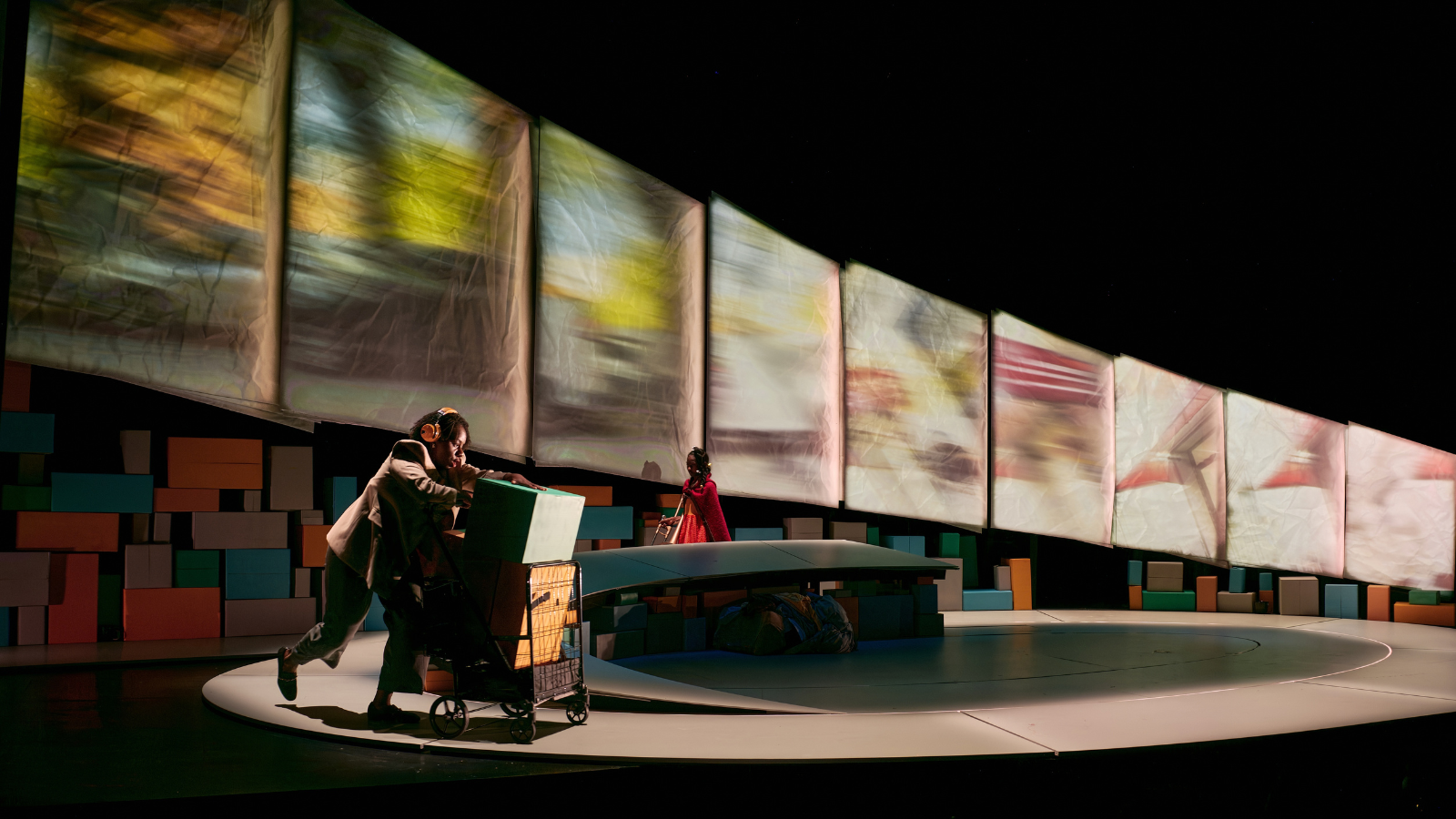
creation stories, now at LCT3’s Claire Tow Theatre through November 1, is a semi-biographical piece and not part of the Ufot cycle. This dreamy work centers on an overburdened writer in her 30s, referred to only as “The Grown Woman”, who is pushing through daily life while struggling through unsuccessful IVF treatments. She is trailed by The Little Girl (Savannah Commodore), a sprightly figure who seeks to lure Grown Woman back to a sense of play.
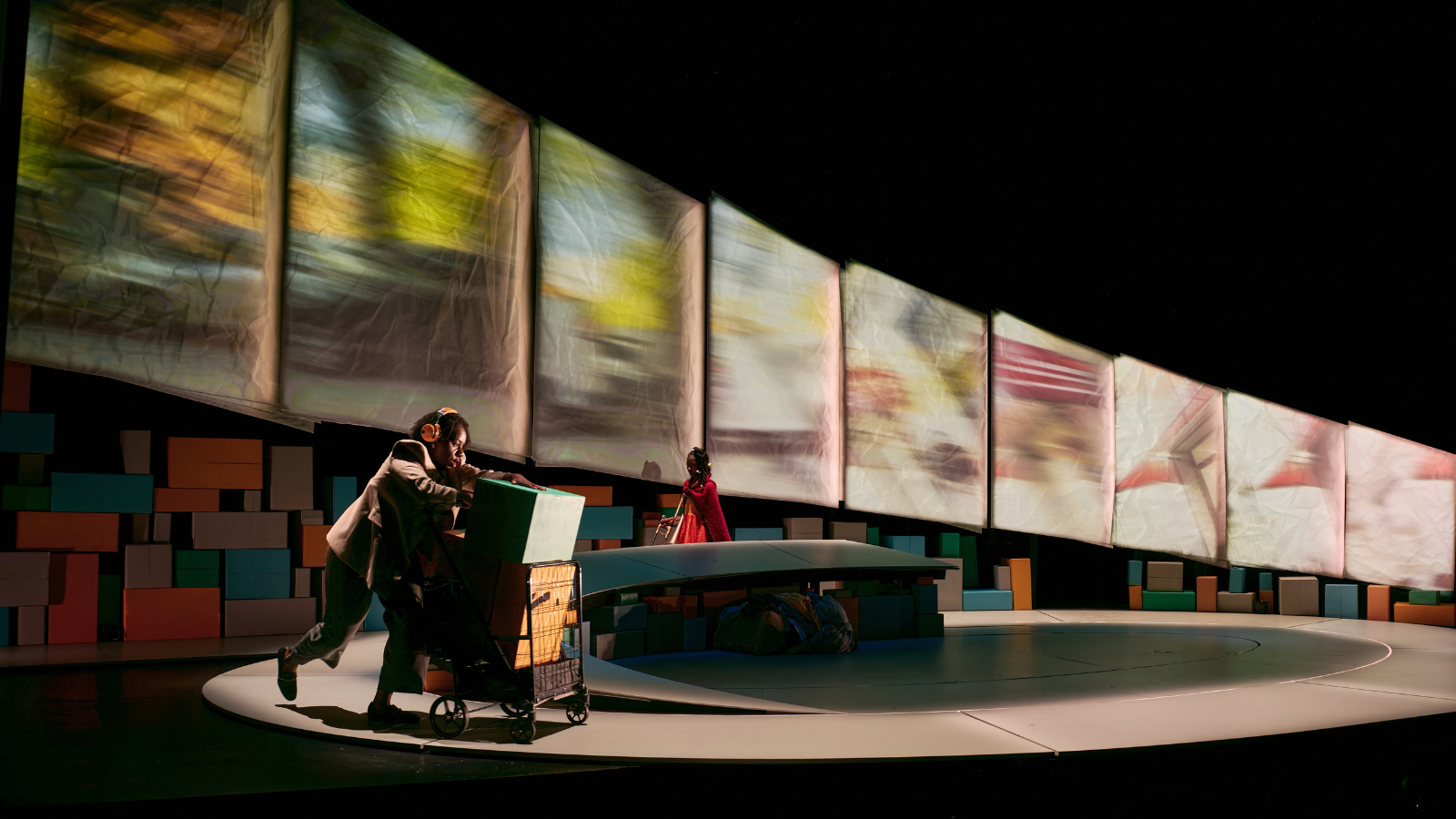
As a text, creation stories is crafted as poetry in motion. Grown Woman pushes through her day—exercise, phone calls, doctors appointments, classes—repeating to herself, “Forward, forward.” An astonishing Abigail C. Onwunali circles and circles on Jason Ardizzone-West’s set, which resembles an indoor play center. Plot-wise, not a whole lot happens. And yet so much happens: Grown Woman is on the verge of collapse, and Udofia is concocting a chimerical reverie inside her buckling mind.
Though Tamilla Woodward’s staging aims for the ethereal quality that Udofia’s writing demands, we never quite get there. It rarely feels like Woodward can break the rules with the same delight as Udofia. Even when the text moves entirely into the land of imagining, the space remains literal and the tone sleepy. It falls on Onwunali to carry us into that dreamland—and she nearly pulls it off, carrying a mammoth text and delivering a heartwrenching performance.
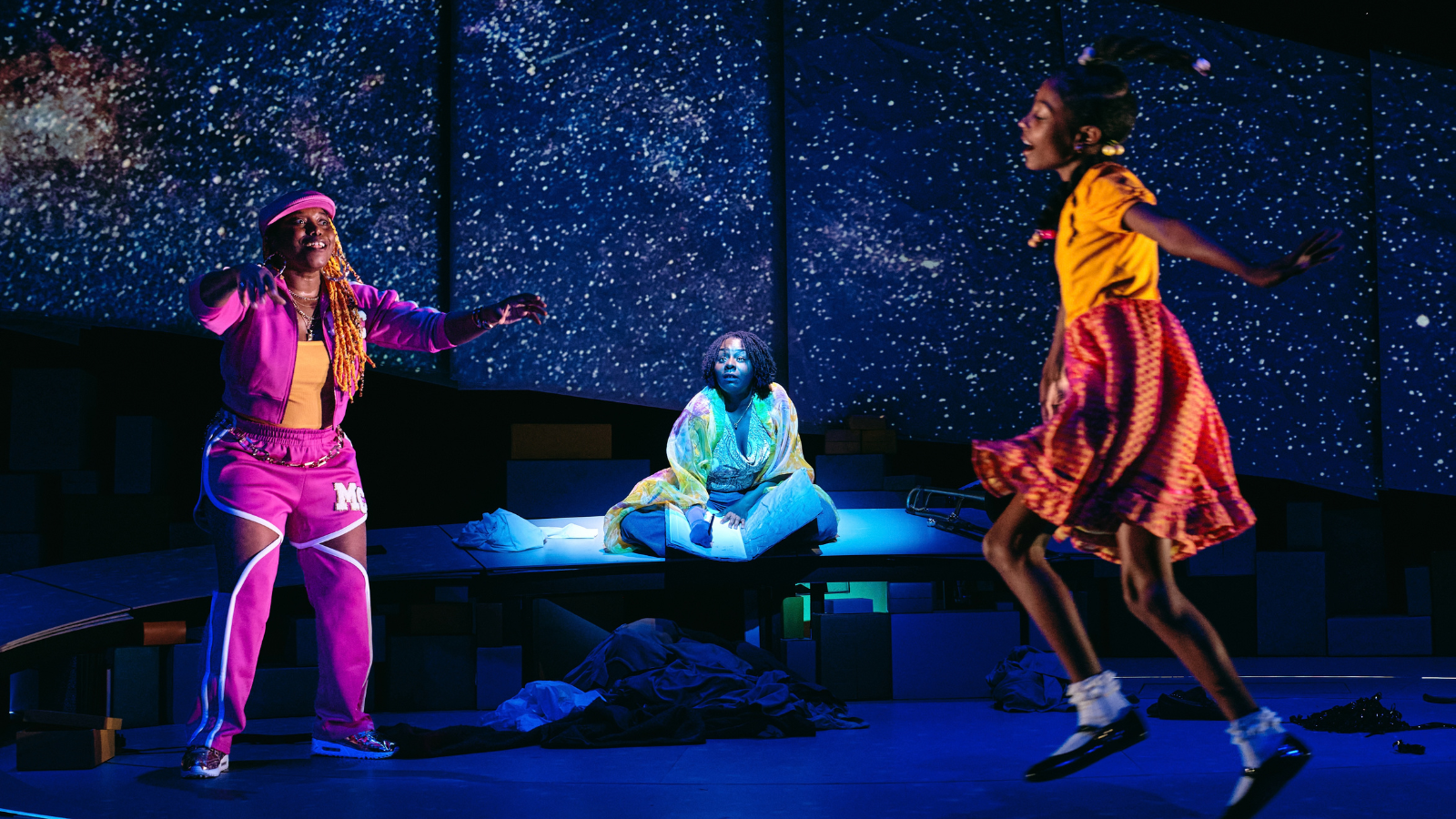
That said, text and production do find a stunning coalescence in one sequence: when Little Girl forces Grown Woman into a moment of stillness by playing Gustav Holst’s “Jupiter,” from orchestral suite The Planets. The action pauses, and the two live in the music. Grown Woman sways and cries; Little Girl dances. For a moment, we are in another reality. And it feels so right.
The proverbial “goat” that barges into Jacob Ming-Trent’s How Shakespeare Saved My Life is, improbably enough, turtle-like video game villain Bowser. Yes, as in the antagonist of the Super Mario gaming universe.
Bowser makes his surprising entrance as Ming-Trent recalls a frightening first experience taking the hallucinogenic drug PCP. The animated monster shoots past on the back wall, chasing a mini-projection of Ming-Trent himself. (Projection designs are by Alexander V. Nichols.)
This bizarre moment captures the manic, playful tone that writer and performer Ming-Trent, working alongside director Tony Taccone, looks to hit upon with his solo piece. A clown at heart, Ming-Trent is clearly not interested in trauma dumping. He wants to upend the rules of these solo works, which tend to start out fun before a third-act turn into calamity. Why not instead let wackiness and tragedy sit on top of one another, silliness colliding with sadness, all of the emotions mixed in together? Shakespeare got away with it, right?
So, we get Bowser. And we get a Looney Toons-esque sequence where a teenage Ming-Trent is initiated into a new gang via cartoonish beatdown: “Boom,” “THWACK!”
And, we get a truly bizarre fantasy section where a young Ming-Trent attends a production of Othello, then is chased through the streets by white audience members all screaming in unison: “You should play Othello, you should play Othello!” That scene ends with our hero being arrested by a police officer who proclaims, as Ming-Trent keeps resisting: “Othello is a fantastic play—you’re going to jail!”
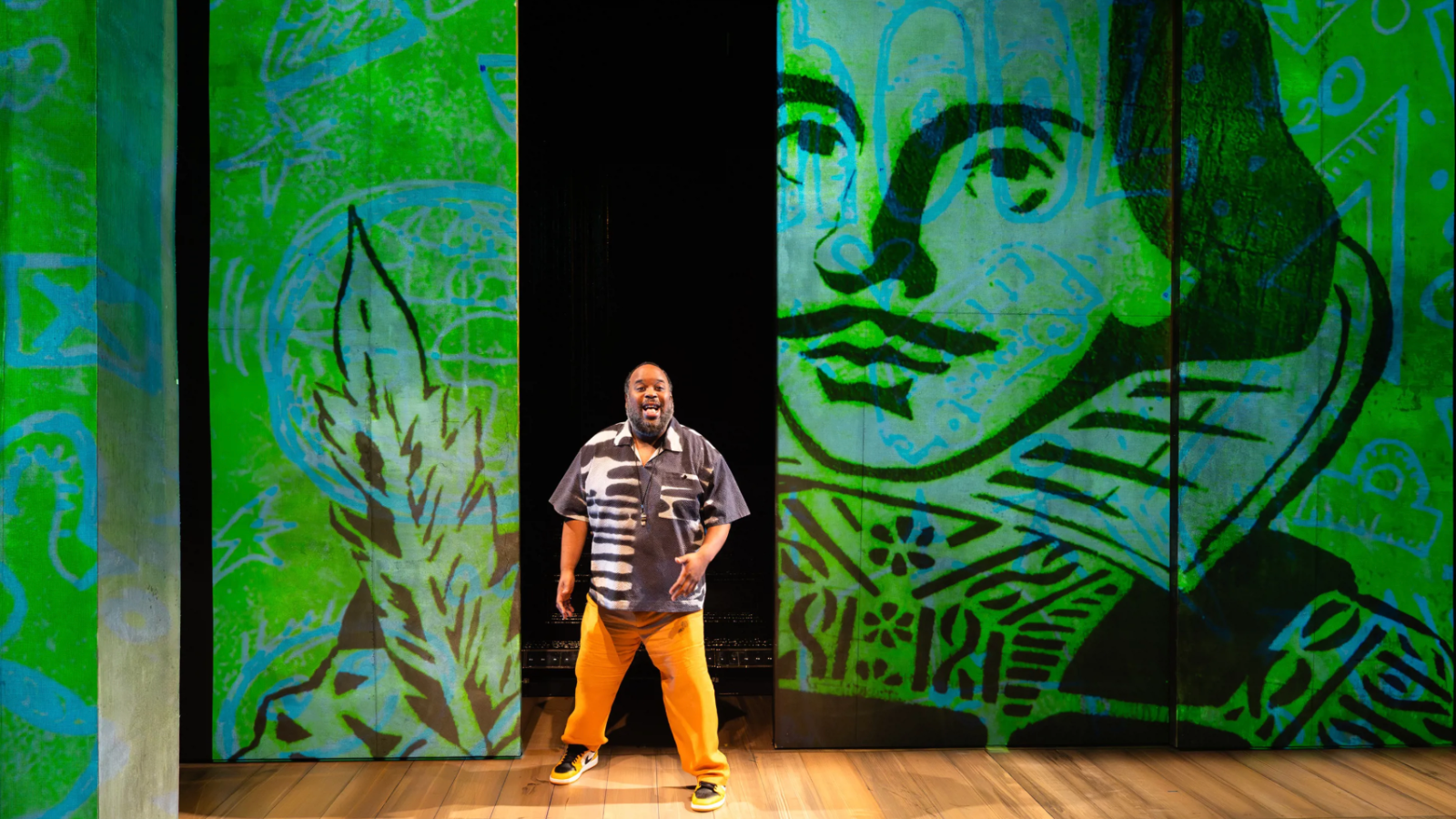
Did Ming-Trent actually get arrested that night? Based on the jail sequence that follows, seemingly yes. But don’t expect any clarity on what actually happened. You’re not gonna get it.
It all sounds fun on paper, but the tone ends up a mess. Taccone’s confused production for Red Bull Theater (a co-production with Berkeley Repertory Theatre and Folger Theatre, presented at The Public Theatre through October 25) is ultimately most successful when it sticks to Shakespeare.
It goes without saying that Ming-Trent is a masterful interpreter of the Bard—his Falstaff in Jocelyn Bioh’s adaptation of Merry Wives of Windsor remains a personal theatrical highlight. He demonstrates that skill every time he slips into soliloquy, and each one speaks powerfully to the challenges facing his teenage self. It’s fun to mix it up, but sometimes, the classics do hit the best.
In terms of tonal mishmash, Joshua Owen’s Human Things sections itself out more clearly: act one of this ambitious work plays as naturalistic drama, with two mismatched couples colliding on a remote island; then act two switches gears entirely to apocalyptic fabulism, as the group confronts the gruesome aftermath of a raging storm.
That quieter first act might be horribly dull if not for a pervading feeling of unease, an unsettled tone that director Rory McGregor holds to carefully. Why is Margaret (Rebeca Robles), a researcher stationed on this island for years, suddenly so unsettled? And does her husband Greg (Ben Rosenfield) not seem oddly cold, almost frightening in his disaffectedness? What is the real story behind the arrival of older couple Darce (two-time Tony Award winner Victoria Clark) and Bo (Tony nominee Michael Mulheren), who have washed up on the island with a questionable backstory?
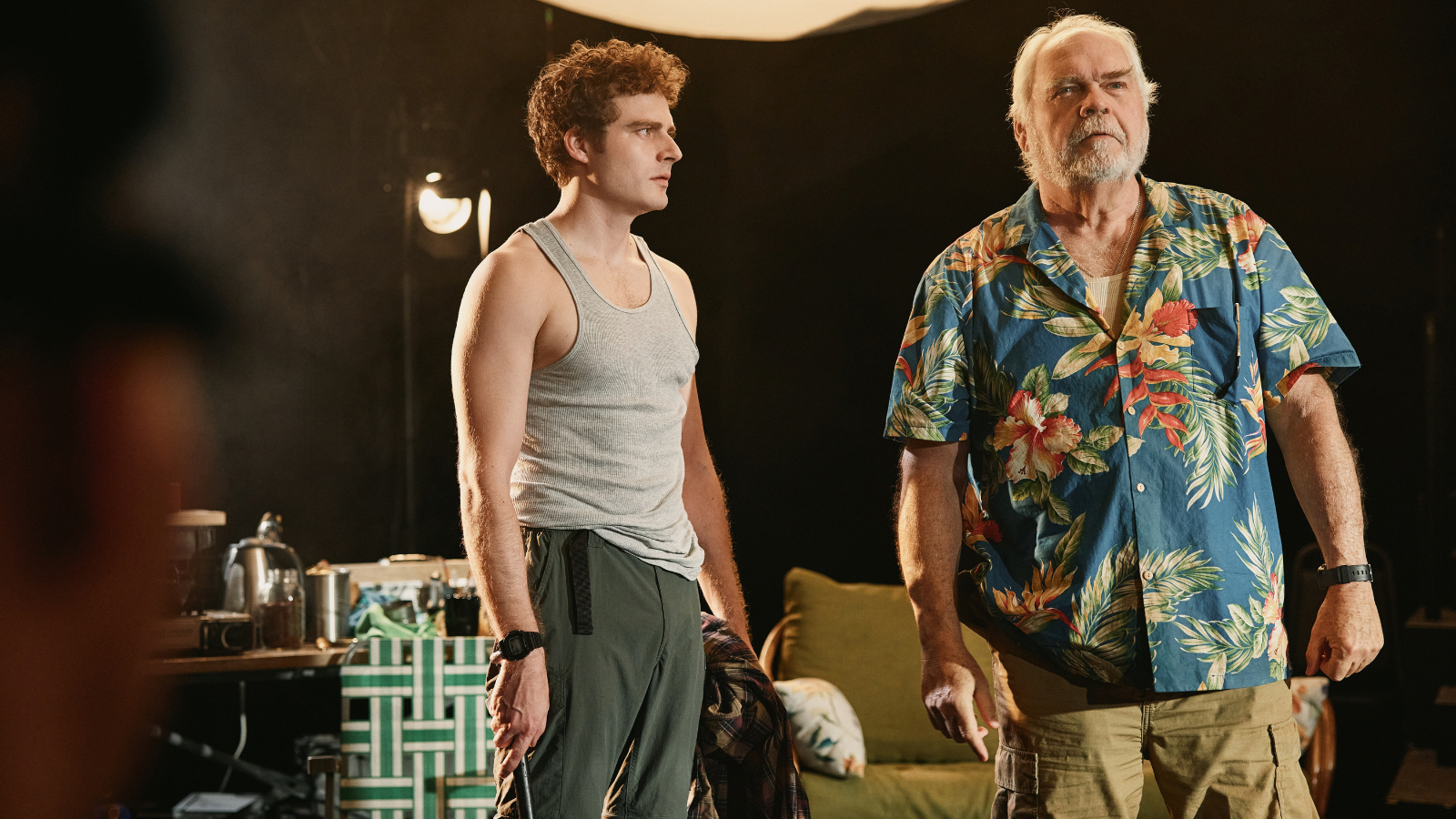
But it’s all a misdirect. Some of these questions are answered, some are not. But having laid the foundations for a secrets-coming-out type talky, Owen pulls the rug out with a raging storm that upends both characters and play. (The storm itself is an impressive bit of staging, with thundering sound from Ian Scot and jump-worthy lighting action from Reza Behjat.)
In the face of overwhelming destruction, the secrets scarcely matter. Survival becomes the only question, one that reveals a cynical look at our basest human instincts. It’s a harsh pivot for sure, one that consciously alienates. But I admit to finding the cold, near-hopeless turn of the play a kind of ugly thrill.
It all culminates in the arrival of another goat—in this case, a giant golden egg covered in spikes. Greg wants to protect it; Margaret views it as a threat. This egg comes totally out of nowhere, and is never explained. I don’t know what the hell it represents. And yet…it felt right. Somehow, that egg just felt right.
Across her rich body of work, playwright Mfoniso Udofia has demonstrated a deep reverence for the traditional rules of a “well-made play”—and an equal enthusiasm for tossing those rules into the garbage.
“Aristotle’s principle of dramatic action, in modern craft terms: A play should imitate one whole action,” explains The Grown Woman, Udofia’s (possible) avatar and the protagonist of her new play creation stories and all the important importants, in a scene addressing her playwriting students. (We, the audience, are the students.) “No scene unless it advances the plot. Just: Cause, Effect, Consequence."
But notice, the Grown Woman continues, how your assignment for the week breaks this rule almost immediately.
“Sometimes, in the middle of a passage you think you comprehend…on walks a goat,” she says. “Some wholly unprepared-for thing that hijacks the narrative. And yet, somehow, infuriatingly, it is all still…”
…it is still right. But when to break the rules? And how to know if you’ve gotten away with it?
In three strange new works now open off-Broadway, a trio of playwrights upend the traditional rules of a “well-made play” with varying levels of success. Jacob Ming-Trent’s solo show How Shakespeare Saved My Life destabilizes the typical structure of a one-man confessional, while Joshua Owen’s drama Human Things seems to reset itself at the halfway point, transforming into an altogether new kind of story.
In other words: Just when I thought I had a handle on each of these plays…on walked a goat.
Udofia is well-practiced in toying with structure. Her nine-play “Ufot Cycle,” a tapestry of stories tracing one Nigerian family over multiple generations of life in the United States, reinvented itself with each successive work. (The cycle concludes in Boston next month with Adia & Clora Snatch Joy at Huntington Theater Company.) Ranging from large ensemble epics to two-person chamber pieces, each play tinkered with form, suggesting unseen forces in the shadows and time collapsing in on itself.
(As an aside: I have seen just four of the eight Ufot plays, and in my dream world, all eight works could one day take over the Public, or Signature, or whatever multi-theater space, allowing audiences to drift freely from one to the next, swimming happily in the rich waters of Udofia’s mind for hours on end.)
creation stories, now at LCT3’s Claire Tow Theatre through November 1, is a semi-biographical piece and not part of the Ufot cycle. This dreamy work centers on an overburdened writer in her 30s, referred to only as “The Grown Woman”, who is pushing through daily life while struggling through unsuccessful IVF treatments. She is trailed by The Little Girl (Savannah Commodore), a sprightly figure who seeks to lure Grown Woman back to a sense of play.
As a text, creation stories is crafted as poetry in motion. Grown Woman pushes through her day—exercise, phone calls, doctors appointments, classes—repeating to herself, “Forward, forward.” An astonishing Abigail C. Onwunali circles and circles on Jason Ardizzone-West’s set, which resembles an indoor play center. Plot-wise, not a whole lot happens. And yet so much happens: Grown Woman is on the verge of collapse, and Udofia is concocting a chimerical reverie inside her buckling mind.
Though Tamilla Woodward’s staging aims for the ethereal quality that Udofia’s writing demands, we never quite get there. It rarely feels like Woodward can break the rules with the same delight as Udofia. Even when the text moves entirely into the land of imagining, the space remains literal and the tone sleepy. It falls on Onwunali to carry us into that dreamland—and she nearly pulls it off, carrying a mammoth text and delivering a heartwrenching performance.
That said, text and production do find a stunning coalescence in one sequence: when Little Girl forces Grown Woman into a moment of stillness by playing Gustav Holst’s “Jupiter,” from orchestral suite The Planets. The action pauses, and the two live in the music. Grown Woman sways and cries; Little Girl dances. For a moment, we are in another reality. And it feels so right.
The proverbial “goat” that barges into Jacob Ming-Trent’s How Shakespeare Saved My Life is, improbably enough, turtle-like video game villain Bowser. Yes, as in the antagonist of the Super Mario gaming universe.
Bowser makes his surprising entrance as Ming-Trent recalls a frightening first experience taking the hallucinogenic drug PCP. The animated monster shoots past on the back wall, chasing a mini-projection of Ming-Trent himself. (Projection designs are by Alexander V. Nichols.)
This bizarre moment captures the manic, playful tone that writer and performer Ming-Trent, working alongside director Tony Taccone, looks to hit upon with his solo piece. A clown at heart, Ming-Trent is clearly not interested in trauma dumping. He wants to upend the rules of these solo works, which tend to start out fun before a third-act turn into calamity. Why not instead let wackiness and tragedy sit on top of one another, silliness colliding with sadness, all of the emotions mixed in together? Shakespeare got away with it, right?
So, we get Bowser. And we get a Looney Toons-esque sequence where a teenage Ming-Trent is initiated into a new gang via cartoonish beatdown: “Boom,” “THWACK!”
And, we get a truly bizarre fantasy section where a young Ming-Trent attends a production of Othello, then is chased through the streets by white audience members all screaming in unison: “You should play Othello, you should play Othello!” That scene ends with our hero being arrested by a police officer who proclaims, as Ming-Trent keeps resisting: “Othello is a fantastic play—you’re going to jail!”
Did Ming-Trent actually get arrested that night? Based on the jail sequence that follows, seemingly yes. But don’t expect any clarity on what actually happened. You’re not gonna get it.
It all sounds fun on paper, but the tone ends up a mess. Taccone’s confused production for Red Bull Theater (a co-production with Berkeley Repertory Theatre and Folger Theatre, presented at The Public Theatre through October 25) is ultimately most successful when it sticks to Shakespeare.
It goes without saying that Ming-Trent is a masterful interpreter of the Bard—his Falstaff in Jocelyn Bioh’s adaptation of Merry Wives of Windsor remains a personal theatrical highlight. He demonstrates that skill every time he slips into soliloquy, and each one speaks powerfully to the challenges facing his teenage self. It’s fun to mix it up, but sometimes, the classics do hit the best.
In terms of tonal mishmash, Joshua Owen’s Human Things sections itself out more clearly: act one of this ambitious work plays as naturalistic drama, with two mismatched couples colliding on a remote island; then act two switches gears entirely to apocalyptic fabulism, as the group confronts the gruesome aftermath of a raging storm.
That quieter first act might be horribly dull if not for a pervading feeling of unease, an unsettled tone that director Rory McGregor holds to carefully. Why is Margaret (Rebeca Robles), a researcher stationed on this island for years, suddenly so unsettled? And does her husband Greg (Ben Rosenfield) not seem oddly cold, almost frightening in his disaffectedness? What is the real story behind the arrival of older couple Darce (two-time Tony Award winner Victoria Clark) and Bo (Tony nominee Michael Mulheren), who have washed up on the island with a questionable backstory?
But it’s all a misdirect. Some of these questions are answered, some are not. But having laid the foundations for a secrets-coming-out type talky, Owen pulls the rug out with a raging storm that upends both characters and play. (The storm itself is an impressive bit of staging, with thundering sound from Ian Scot and jump-worthy lighting action from Reza Behjat.)
In the face of overwhelming destruction, the secrets scarcely matter. Survival becomes the only question, one that reveals a cynical look at our basest human instincts. It’s a harsh pivot for sure, one that consciously alienates. But I admit to finding the cold, near-hopeless turn of the play a kind of ugly thrill.
It all culminates in the arrival of another goat—in this case, a giant golden egg covered in spikes. Greg wants to protect it; Margaret views it as a threat. This egg comes totally out of nowhere, and is never explained. I don’t know what the hell it represents. And yet…it felt right. Somehow, that egg just felt right.


.png)

.png)