


.png)


-copy.webp)


.png)


%20copy.webp)



Playwright Jon Robin Baitz extends tremendous empathy to every member of the central family in Other Desert Cities, his 2011 drama now receiving a high-wattage Broadway revival led by Seinfeld and Veep star Julia Louis-Dreyfus. Yet for myself, finding resonance in Baitz’s 15-year-old work required viewing every character on stage with a degree of retroactive contempt.
If regarded with such disdain, the central Wyeth clan become—at least by the play’s conclusion—something fascinating. This wealthy Republican dynasty become a kind of root cause, a frightening representation of the apathy, disengagement and cynicism that led us to our current political moment. It’s an intriguing notion, at least to me. Whether it is remotely the intention of either play or production, of course, is another question.
A critical hit and Pulitzer finalist back in 2011, Other Desert Cities is set in the deserts of Palm Springs, California in Bush-era 2004 as the Wyeths gather on Christmas Eve. Family patriarch Lyman Wyeth (Ed Harris), an actor-turned-ambassador who shifted into Republican politics under Reagan, is a kindly figure. His wife Polly Wyeth (Julia Louis-Dreyfus), a former screenwriter and leftist whose politics lurched rightward to match her husband’s, has a crueler nature. Polly’s embrace of a GOP power player status has strained the dynamic with her sister Silda (Allison Janney), a fiery liberal and barely-recovering alcoholic.
Eldest daughter Brooke (Lily Rabe) brings home an unwelcome holiday surprise: the manuscript of her new memoir, a book focused on the radicalization and death of her older brother Henry. Brooke is still struggling to recover from the loss of Henry, who joined a radical underground movement and ultimately took his own life after an attack by the group left one person dead. These are not events that her parents wish to relive, and despite an effort by younger brother Trip (Joe Keery) to defuse tensions, Brooke’s new book re-opens old wounds and dredges up long held family secrets.
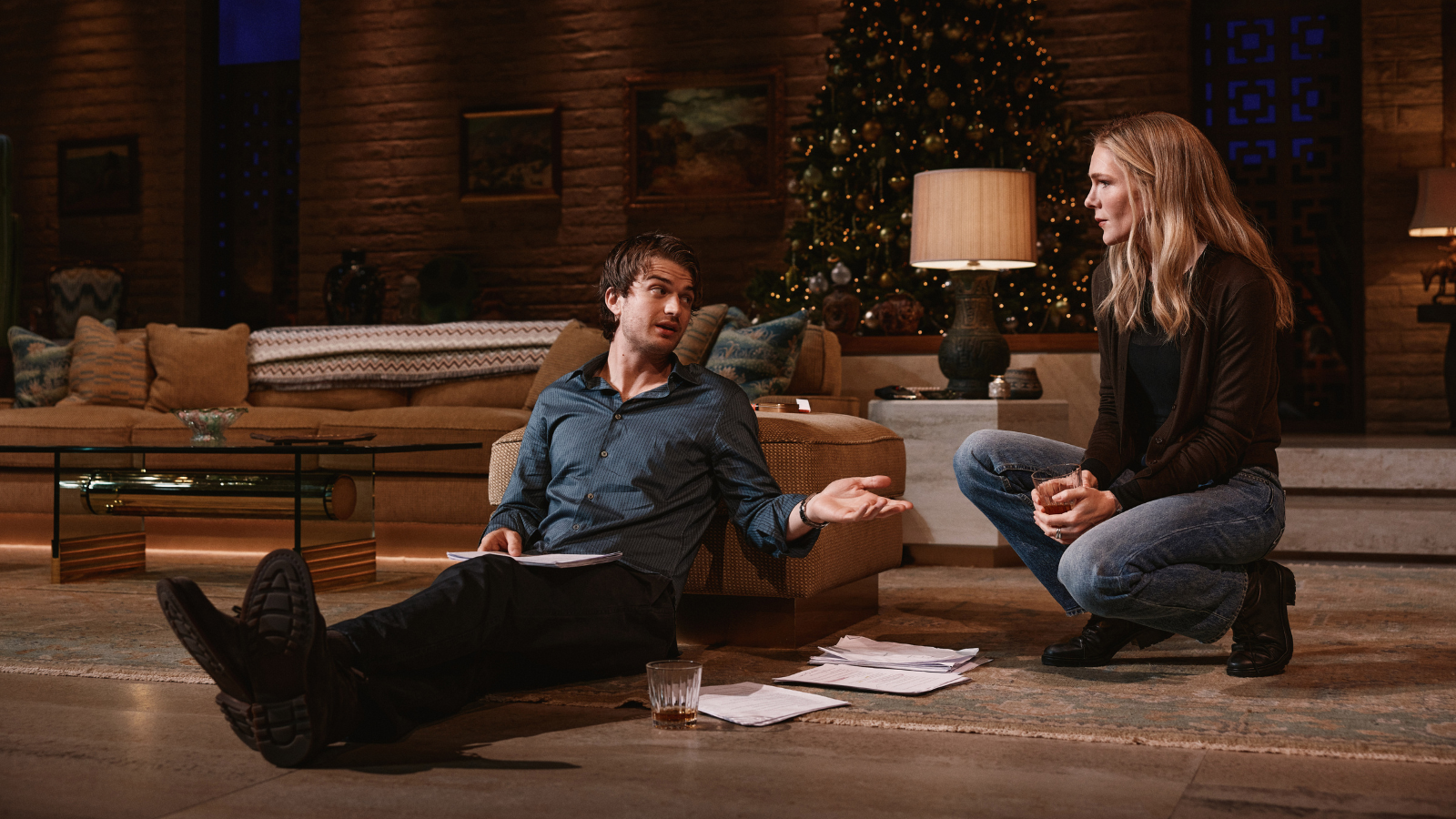
Other Desert Cities is an undeniably satisfying piece of narrative drama, tightly constructed and rigorously paced. Baitz doles out information with careful precision; each mini-confrontation flows naturally into the next, building a detailed overall picture; satisfyingly deployed monologues flesh out each character with compassion and care. This is, formally speaking, a very good play.
The deftness of Baitz’s dramatic construction offsets, here, a merely serviceable staging by director John Benjamin Hickey for this revival (at the Hudson Theatre, through January 17). Best known as an actor, Hickey’s only previous Broadway credit, Plaza Suite, was a brutally languid affair. Hickey certainly fairs better here, but his blocking is noticeably awkward, leaving actors to wander on-and-off stage uncertainly; and much of Baitz’s sharp dialogue is deployed sluggishly by actors who should be spitting the words like acid.
Of the production’s two genuine cast standouts, one is unsurprising: stage veteran Lily Rabe is both heartbreaking and appropriately annoying as Brooke, a high-intensity individual struggling with deep wells of pain. Rabe is not exactly restrained here, but her severity feels truthful. A greater surprise is Joe Keery, of Stranger Things fame, a natural stage presence who carefully reveals the confusion and torment lurking under Trip’s surface aloofness.
Harris and Janney, both stage veterans, feel oddly underpowered in roles that should land much stronger. The keen political operator under Lyman’s sweetness scarcely registers, while Janney’s halfhearted delivery is a far cry from the blistering intensity that Judith Light brought to the role 15 years ago. (I did not see her live, admittedly, but those YouTube clips are seared indelibly into my memory.)
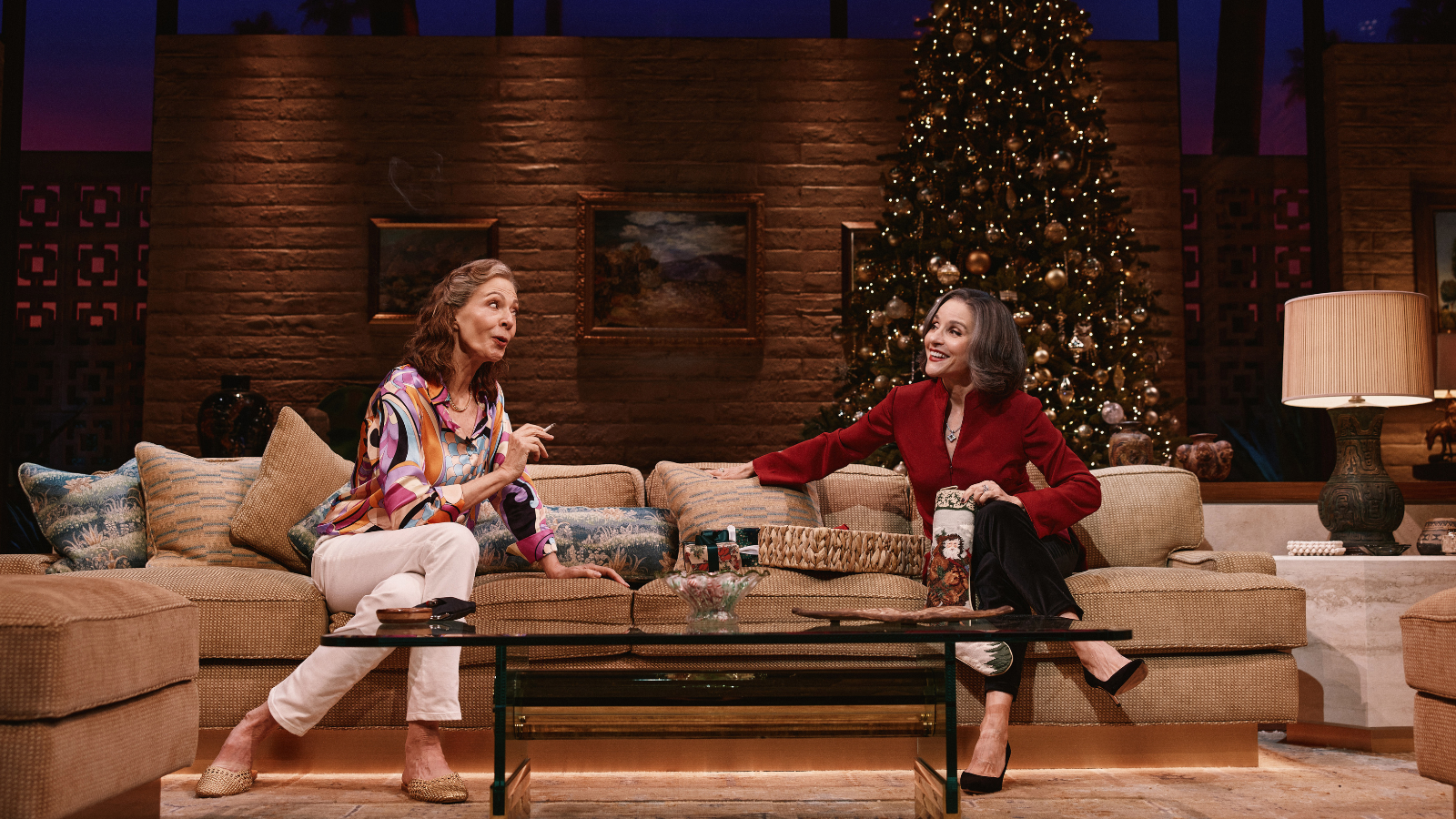
Perhaps Janney should have swapped roles with Louis-Dreyfus, who sadly cannot muster the regal status demanded by the matriarch role of Polly. (Louis-Dreyfus is also saddled with a hideous wig, a distractingly ugly gray bob.) The Seinfeld and Veep star lands her character’s cruel barbs as punchlines, and does get the laughs. But Polly’s demeaning, occasionally racist remarks should reveal a truly vicious figure. Instead, she feels sitcom-mean, à la Selina Myer, rather than truly heartless.
Of course, one could argue that Polly isn’t supposed to be a total void of emotion, which brings us back to the play’s intriguing contemporary resonance. Baitz’s play builds to a reveal that seems intended to throw our previous understanding of Polly and Lyman into stark relief, suggesting the two are far less heartless than they appear. But for me, the reveal had much the opposite effect, seeming to confirm the pair’s obsession with pristine surface appearance over any genuine care for others.
“You can do what you like after we’re gone!” begs Lyman at one point, imploring his daughter to delay her book. “Do you not understand that? It’s simply good manners.”
“I am past the point of good manners,” insists Brooke.
She’ll end up going back on these words, moved by a family secret that feels like a variation on the previous cruel lie. The tragedy of this play’s ending, to me, is that of its only character with any remaining principle ultimately giving up, and giving in to ease and comfort.
Given how Hickey directs the final scenes, I doubt he shares this viewpoint; he and Baitz likely see it as a more nuanced affair. And in 2011, perhaps it still was. But today, one can trace a lot of pain and suffering to the Pollys and Lymans of the world, power players who prized “good manners” over speaking truth. All of this gives the conclusion of Other Desert Cities a depressing kind of resonance, if perhaps not the kind its creators intended.
Other Desert Cities is now in performance at the Hudson Theatre on West 44th Street in New York City. For tickets and more information, visit here.

Playwright Jon Robin Baitz extends tremendous empathy to every member of the central family in Other Desert Cities, his 2011 drama now receiving a high-wattage Broadway revival led by Seinfeld and Veep star Julia Louis-Dreyfus. Yet for myself, finding resonance in Baitz’s 15-year-old work required viewing every character on stage with a degree of retroactive contempt.
If regarded with such disdain, the central Wyeth clan become—at least by the play’s conclusion—something fascinating. This wealthy Republican dynasty become a kind of root cause, a frightening representation of the apathy, disengagement and cynicism that led us to our current political moment. It’s an intriguing notion, at least to me. Whether it is remotely the intention of either play or production, of course, is another question.
A critical hit and Pulitzer finalist back in 2011, Other Desert Cities is set in the deserts of Palm Springs, California in Bush-era 2004 as the Wyeths gather on Christmas Eve. Family patriarch Lyman Wyeth (Ed Harris), an actor-turned-ambassador who shifted into Republican politics under Reagan, is a kindly figure. His wife Polly Wyeth (Julia Louis-Dreyfus), a former screenwriter and leftist whose politics lurched rightward to match her husband’s, has a crueler nature. Polly’s embrace of a GOP power player status has strained the dynamic with her sister Silda (Allison Janney), a fiery liberal and barely-recovering alcoholic.
Eldest daughter Brooke (Lily Rabe) brings home an unwelcome holiday surprise: the manuscript of her new memoir, a book focused on the radicalization and death of her older brother Henry. Brooke is still struggling to recover from the loss of Henry, who joined a radical underground movement and ultimately took his own life after an attack by the group left one person dead. These are not events that her parents wish to relive, and despite an effort by younger brother Trip (Joe Keery) to defuse tensions, Brooke’s new book re-opens old wounds and dredges up long held family secrets.
Other Desert Cities is an undeniably satisfying piece of narrative drama, tightly constructed and rigorously paced. Baitz doles out information with careful precision; each mini-confrontation flows naturally into the next, building a detailed overall picture; satisfyingly deployed monologues flesh out each character with compassion and care. This is, formally speaking, a very good play.
The deftness of Baitz’s dramatic construction offsets, here, a merely serviceable staging by director John Benjamin Hickey for this revival (at the Hudson Theatre, through January 17). Best known as an actor, Hickey’s only previous Broadway credit, Plaza Suite, was a brutally languid affair. Hickey certainly fairs better here, but his blocking is noticeably awkward, leaving actors to wander on-and-off stage uncertainly; and much of Baitz’s sharp dialogue is deployed sluggishly by actors who should be spitting the words like acid.
Of the production’s two genuine cast standouts, one is unsurprising: stage veteran Lily Rabe is both heartbreaking and appropriately annoying as Brooke, a high-intensity individual struggling with deep wells of pain. Rabe is not exactly restrained here, but her severity feels truthful. A greater surprise is Joe Keery, of Stranger Things fame, a natural stage presence who carefully reveals the confusion and torment lurking under Trip’s surface aloofness.
Harris and Janney, both stage veterans, feel oddly underpowered in roles that should land much stronger. The keen political operator under Lyman’s sweetness scarcely registers, while Janney’s halfhearted delivery is a far cry from the blistering intensity that Judith Light brought to the role 15 years ago. (I did not see her live, admittedly, but those YouTube clips are seared indelibly into my memory.)
Perhaps Janney should have swapped roles with Louis-Dreyfus, who sadly cannot muster the regal status demanded by the matriarch role of Polly. (Louis-Dreyfus is also saddled with a hideous wig, a distractingly ugly gray bob.) The Seinfeld and Veep star lands her character’s cruel barbs as punchlines, and does get the laughs. But Polly’s demeaning, occasionally racist remarks should reveal a truly vicious figure. Instead, she feels sitcom-mean, à la Selina Myer, rather than truly heartless.
Of course, one could argue that Polly isn’t supposed to be a total void of emotion, which brings us back to the play’s intriguing contemporary resonance. Baitz’s play builds to a reveal that seems intended to throw our previous understanding of Polly and Lyman into stark relief, suggesting the two are far less heartless than they appear. But for me, the reveal had much the opposite effect, seeming to confirm the pair’s obsession with pristine surface appearance over any genuine care for others.
“You can do what you like after we’re gone!” begs Lyman at one point, imploring his daughter to delay her book. “Do you not understand that? It’s simply good manners.”
“I am past the point of good manners,” insists Brooke.
She’ll end up going back on these words, moved by a family secret that feels like a variation on the previous cruel lie. The tragedy of this play’s ending, to me, is that of its only character with any remaining principle ultimately giving up, and giving in to ease and comfort.
Given how Hickey directs the final scenes, I doubt he shares this viewpoint; he and Baitz likely see it as a more nuanced affair. And in 2011, perhaps it still was. But today, one can trace a lot of pain and suffering to the Pollys and Lymans of the world, power players who prized “good manners” over speaking truth. All of this gives the conclusion of Other Desert Cities a depressing kind of resonance, if perhaps not the kind its creators intended.
Other Desert Cities is now in performance at the Hudson Theatre on West 44th Street in New York City. For tickets and more information, visit here.

The Fantasticks legendary run cemented itself in New York City history, and now longtime friends Nathan Levy and Maxim Chlumecky are bringing it to a new generation — with an important queer twist.
I recently caught up with the dynamic duo to chat about their long time relationship, their feelings bringing the iconic musical to Broadway, and more.
This interview has been edited and condensed for length and clarity.
Theatrely: Nathan, why don't we start with you, how did this project come into your life?
Nathan Levy: I was literally about to go on a solo trip to Guatemala. This was like, April, April. And Max and I had the same agent and he called and said they're just doing this one day, casual reading of the show, mostly just to focus on like the new script and the rewrites they're doing. And so I tried not to get too attached, which was impossible. And yeah, it was just a one day casual thing with Max, which was the best.
Theatrely: When you heard, when your agents first told you that this was a project, what went through your heads? Were you both familiar with the show?
Maxim Chlumecky: Well, I remember seeing the announcement and seeing that it was a gay retelling of it. And I mean, I'd seen the show before, but I immediately just felt super attached to it from the get. And yeah, I mean the music is so beautiful. And yeah just to even do that reading from the beginning was so cool.
Theatrely: Nathan, had you seen the show before?
Nathan: My junior year of high school, my high school did it. And full transparency, I was not really paying attention to the show. My best friend did play Louisa though, so I was really just supporting her. But at the time I thought it was beautiful and good classic musical theater, which it still is.
Theatrely: I want to hear from both of you when you found out you got the role, how did that go?
Nathan: Oh my god, it was a crazy day for both of us. I auditioned at noon and then I had a matinee at two, finished the matinee, literally was in the house of the Stephen Sondheim Theatre and got a call. We're famously in a basement, so the service is not great, so I had to be in the theatre and I was just freaking out. I fell to the floor. I had known that Max also had booked it too, which was just like the cherry on top. It was crazy.
Max: I was in Aspen doing a contract and I got a call saying that there was a final callback for it. I was kind of kicking myself because I was across the country and Aspen is famously very hard to get in and out of. You have to take a plane to another plane because of the elevation and all the nonsense, so I booked a flight for the night before the audition. I got there and then I had an audition and read with Nathan — that was a fucking dream — and then I immediately left the audition, went straight to the airport, and was just decompressing and probably overthinking every single move that we did. Our agent called me, and just as I was about to board the plane back to Aspen. Everything went blank; it was insane. He was like, “Nathan's in a matinee right now, so I'm about to tell him,” but I was about to board a plane, so I wasn't going to be able to have any service. So I was like, “can you just tell Nathan that I love him while I'm on the plane?” I landed and I had like 17 texts from Nathan, and it was a really lovely day.
Theatrely: When did you two first meet?
Nathan: We met a long time ago. Max is a year above me at school. We went to school together. I came to Pace for a prospective students weekend from California, so I actually stayed with Max and his roommates in their freshman dorm, which is crazy.
Max: Which he reminded me of a few weeks ago and I had totally forgotten about it. Like it was somewhere in the crevices of my memory. We fully hosted him for a night. One night and he slept on the floor because we were like, “we have to humble you.” And that's when we met. We did school for the next few years together, but we never did a show together there.
Nathan: Until now.
Max: We are waiting for the perfect moment.
Theatrely: Crazy. What do you both admire about each other as performers?
Nathan: Well, Max has always been the smartest. Like, he can't not be truthful in his acting. I'm gassing you up. It's true. Literally the second I got to school, it was just obvious that he was that fucking guy. He was that actor, like, truly. Like, everyone, everyone knew it.
Max: It's funny because like the second Nathan got to school, I feel like there was like a rupture of events because he's always just been the star there. Did you leave school?
Nathan: I left halfway through junior year.
Max: Nathan is one of those kids in school who leaves because he's too talented and doesn't need to be going to school for this because he is doing it professionally. He left school his junior year, but you graduated, right?
Nathan: I did, thank you COVID.
Max: Talent. I mean, he graduated and was working. Oh, COVID. That's right. Yeah, he left to do Dear Evan Hansen. And quite frankly, he's never stopped working since then. So the proof is in the pudding. And if there's no there's, yeah, if someone's just already doing what they're going to school for, I think that speaks for itself.
Theatrely: Yes. I want to talk about obviously the big news that this is a new interpretation [of The Fantasticks] surrounding a young gay couple. I'm curious how you both feel knowing that you will be that representation of young queer love for this new generation and how that sits with you right now, before you even begin this process.
Nathan: What I think is so interesting and special about how we're doing this production is, yes, this is a new queer love story lens on this classic old school musical, but queerness isn't the main conflict or struggle.
Max: They're not tortured by themselves being gay.
Nathan: Yeah, it just is a part of the story, which I think is moving forward for future generations of younger queer people to see theatre is so much more impactful when you see a show and it just is. It’s not beating you over the head with it or making it, like Max said, the struggle, but I think that's the best part of it.
Max: Yeah, I totally agree. I mean, to see a queer love story that's actually just about the struggles of a relationship itself instead of it. There are so many stories about queer love that there are so many different versions that are valid and everything. But it’s so cool for, I think, there's one moment in the show where someone questions it, where it's like two men and somebody says like, “yes,” and then you move on. And it's so lovely to just see a queer relationship that's just talking about the joys and struggles of love itself and not so much about how hard it is to be gay. I'm so thrilled to be able to tell the story through a gay lens as well. Also, I find with such a classic show like this, that's such a big part of New York history. The fact that this was originally re-conceived by the writer himself, Tom Jones, who unfortunately passed away. In the last few years of his life, this was his project, to re-conceive it as a gay story. That's very vulnerable, I feel like, for a writer to be able to do, to change such a classic story. He has other works, he and Harvey Schmidt, but this is probably the one he’s most known for. For him to take his most prized possession and turn it on its head and be able to take that risk — despite criticism or controversies — it's so incredible. The fact that we get to do this is so, so special to me. It's not lost on us.
Theatrely: Theaterly is very much meant for the younger theatre-goer, a more Gen Z crowd. When young folks come and see this musical, many of whom I assume may have never seen The Fantasticks in any version, what do you hope young people take away when they come see your show?
Nathan: This show opened in 1960 off-Broadway, and it ran for 42 years. Anyone under 25 probably doesn’t remember that, so like they're seeing this show with a completely fresh lens in 2026. I hope it just enlightens that sort of musical genre to people. There’s beautiful singing, but it's just a true, beautiful love story that was written a long time ago and I hope it opens up their eyes to that.
Max: Yeah, this is New York theatre DNA. In a world where lots of different theatre is going on at the same time and very different theatre to what The Fantasticks is and what theatre was back then, it's opportunity for young people not only to see it in a contemporary way that they might appreciate now, but for them to just witness theatre in its purest form. It's not going to be a recreation of the original production but it's going to honor the simplicity and the purity of the original production, so it's an opportunity for them to see New York theatre history. When I talk to people about the show, I feel as though it's either, “oh my god, I love this show so much,” or “I don't know anything about it.” So it should be really fun to see. I feel as though the people who don't know as much about it are people who are younger and Gen Z. Just the fact that they kind of get the opportunity to see it and to get to know it is awesome.
Theatrely: Is there another classic musical in the canon that you would love to see remade through a queer lens?
Nathan: Like a true classic? Maybe Bye Bye Birdie or something, that was the first show I ever did.
Max: I don't know why, but Sweeney [Todd] is coming to mind.
Nathan: Queer Sweeney!
Max: Oh, maybe Oklahoma! I feel like there's a better answer, so maybe I'll come back to you on that.


